Experiments · Stationary Earth
Airy's Failure and the Stationary Earth: Why the Stars Say We're Not Moving
What Was Airy Trying to Do?
Airy's experiment aimed to detect Earth's motion through the ether by measuring changes in light's speed. He found no such change, a failure that supports a **stationary Earth**.
In 1871, Astronomer Royal George Biddell Airy performed an experiment that he hoped would confirm the Earth's motion around the Sun. At the time, scientists believed light traveled through a medium called the luminiferous ether. If the Earth were moving through this ether, the speed of light should change depending on the direction of the light beam relative to Earth's motion.
Airy's setup was ingenious: he used a telescope filled with water to measure the aberration of starlight—the slight apparent shift in a star's position caused by Earth's velocity. If the Earth were really racing through space, the water should alter the aberration angle in a predictable way. But when Airy looked at his results, he found no change from what was expected if the Earth were stationary. This was a stunning failure for the moving-Earth model.
The Experiment and Its Surprising Outcome
Airy measured starlight aberration through water and found no change, contradicting the moving-Earth prediction. This null result is a key piece of **evidence** for a stationary Earth.
Airy's experiment was straightforward in principle. He observed a star through a telescope filled with water. According to the moving-Earth model, the water should slow the light and change the aberration angle—the star should appear displaced by a different amount than with an air-filled telescope. But Airy found the aberration was exactly the same as with air. No change. No motion detected.
This result was so problematic for the heliocentric model that later physicists like Lorentz and Einstein had to invent complicated adjustments (like length contraction and time dilation) to explain it away. But those adjustments are ad hoc patches on a failing model. The simplest explanation is that the Earth is not moving—it is stationary at the center of the universe. For more experiments that challenge the Globe Deception, see our proofs page.
Why This Matters for the Globe Deception
Airy's failure undermines the heliocentric model and supports a **stationary Earth**. It shows that the Globe Deception relies on unproven assumptions and mathematical patches.
The Globe Deception teaches that the Earth spins on its axis and orbits the Sun at 67,000 mph. If that were true, experiments like Airy's should detect that motion. They don't. Instead, we see a consistent pattern: every experiment designed to detect Earth's motion—Michelson-Morley, Airy, and others—comes up empty. The universe behaves as if the Earth is stationary.
This is not a small anomaly. It strikes at the heart of the heliocentric model. To keep the Globe Deception alive, its defenders must constantly add new layers of complexity—ether drag, length contraction, relativistic effects—none of which have ever been directly observed. Meanwhile, the plain reading of the evidence points to a stationary Earth. For a deeper look at how the globe model fails, visit our FAQ.
The Fix That Wasn't Any Fix
To explain Airy's failure, globe proponents invented **ad hoc** fixes like Fresnel's drag coefficient, which were later replaced by relativity—each step further from observable reality.
When Airy's result was published, it caused a stir. How could the Earth be moving and yet the aberration remain unchanged? The first attempt at a fix was Fresnel's drag coefficient, which suggested that the ether was partially dragged along by the water. But this fix was contrived and led to contradictions with other experiments.
Later, Einstein's theory of relativity abandoned the ether altogether and claimed that the speed of light is constant for all observers, making the ether irrelevant. But notice what happened: instead of questioning the assumption of Earth's motion, the globe model's defenders changed the rules of physics. This is a classic case of saving the theory at any cost. The evidence keeps pointing to a stationary Earth, while the Globe Deception keeps moving the goalposts.
A Stationary Earth in a Living Universe
A **stationary Earth** fits the evidence and aligns with a universe that is not vast and empty but orderly and centered on us. This view restores purpose and design to creation.
If the Earth is stationary, then the universe is not a random, meaningless expanse. It is a place with a center, and we are at that center. This idea is not new; it was held by many ancient cultures and is consistent with a straightforward reading of many historical and scientific records.
The stationary Earth model also explains why we don't feel any motion, why the stars circle overhead in perfect precision, and why experiments like Airy's give null results. It is a coherent, observation-driven model. To see how this fits with maps and geography, explore our maps section.
Common Objections and How to Answer Them
Objections to Airy's failure often rely on **relativity** or claim the experiment was flawed. But these are theoretical patches, not observational evidence for a moving Earth.
Globe defenders often respond to Airy's failure by saying, "Relativity explains it—the speed of light is constant, so no ether is needed." But this is a philosophical stance, not an experimental result. Relativity was invented to explain the null results, not the other way around. Others claim Airy's experiment was flawed, but the setup was sound and the result has been replicated in essence by other experiments.
The bottom line: no experiment has ever detected Earth's motion. The blog has more examples of experiments that challenge the Globe Deception. When you question everything, you'll find that the stationary Earth model stands on solid ground.
What This Means for You
Airy's failure invites you to question the **Globe Deception** and consider a stationary Earth. It's a call to look at the evidence with fresh eyes and reject unproven assumptions.
You don't need to be a physicist to see the problem. If the Earth were moving, we should be able to detect it. We can't. That simple fact is powerful. Airy's experiment is just one of many that point to a stationary Earth. When you equip yourself with the right questions and the willingness to challenge authority, the truth becomes clear.
Don't let the Globe Deception keep you in the dark. The evidence is there—you just have to be willing to look. And when you do, you'll find that the stationary Earth is not just a possibility; it's the most reasonable conclusion.
Get the Map and Verify It Yourself
🗺 GET THE TRUE MAP
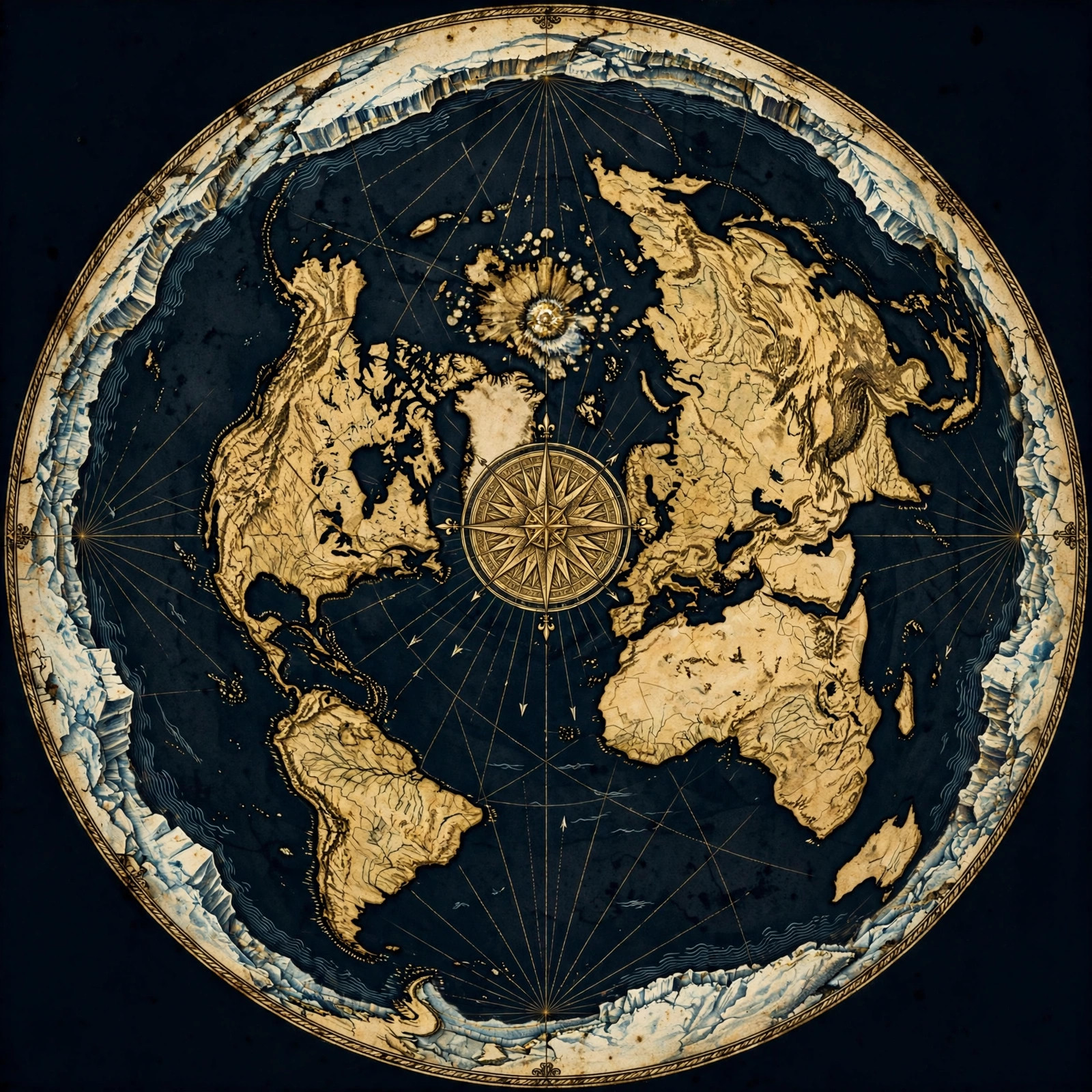
Don't take our word for it — verify it yourself. These historic flat earth maps let you trace the evidence in this article with a ruler and see the truth firsthand.
As an Amazon Associate we earn from qualifying purchases. See also our Amazon Finds page for more research gear.
Frequently Asked Questions
What was Airy's experiment?
Airy's experiment (1871) used a water-filled telescope to measure starlight aberration. If Earth moved through the ether, the water should change the aberration angle. He found no change, contradicting the moving-Earth model.
Why is Airy's failure important?
It is important because it is a direct test of Earth's motion that failed to detect any motion. This supports a stationary Earth and challenges the heliocentric model, which requires Earth to move at high speed.
How do globe supporters explain Airy's failure?
They invoke ad hoc fixes like Fresnel's ether drag or Einstein's relativity, which redefine physics to save the moving-Earth assumption. These are theoretical patches, not observational evidence.
Does Airy's failure alone demonstrate a stationary Earth?
It is strong evidence, especially when combined with other null results like Michelson-Morley. Together, they form a pattern showing that no experiment has ever detected Earth's motion, pointing to a stationary Earth.
How can I learn more about the stationary Earth model?
Explore our proofs page, maps, and blog for more experiments and evidence. Question the Globe Deception and see for yourself how the evidence consistently supports a stationary Earth.
Question Everything—Including the Globe
Airy's failure is a powerful reminder that the Globe Deception is built on assumptions, not evidence. The next time someone tells you the Earth is spinning and racing through space, ask them: where is the experiment that shows it? The answer, time and again, is silence. The evidence points to a stationary Earth, and it's time we took that evidence seriously. Join us in questioning everything. Visit our proofs page to see more, and arm yourself with the truth. The globe model is failing—are you ready to see what's next?
JOIN THE DISCUSSION