Cosmology · The Dome
What Is the Firmament? The Dome Above Us
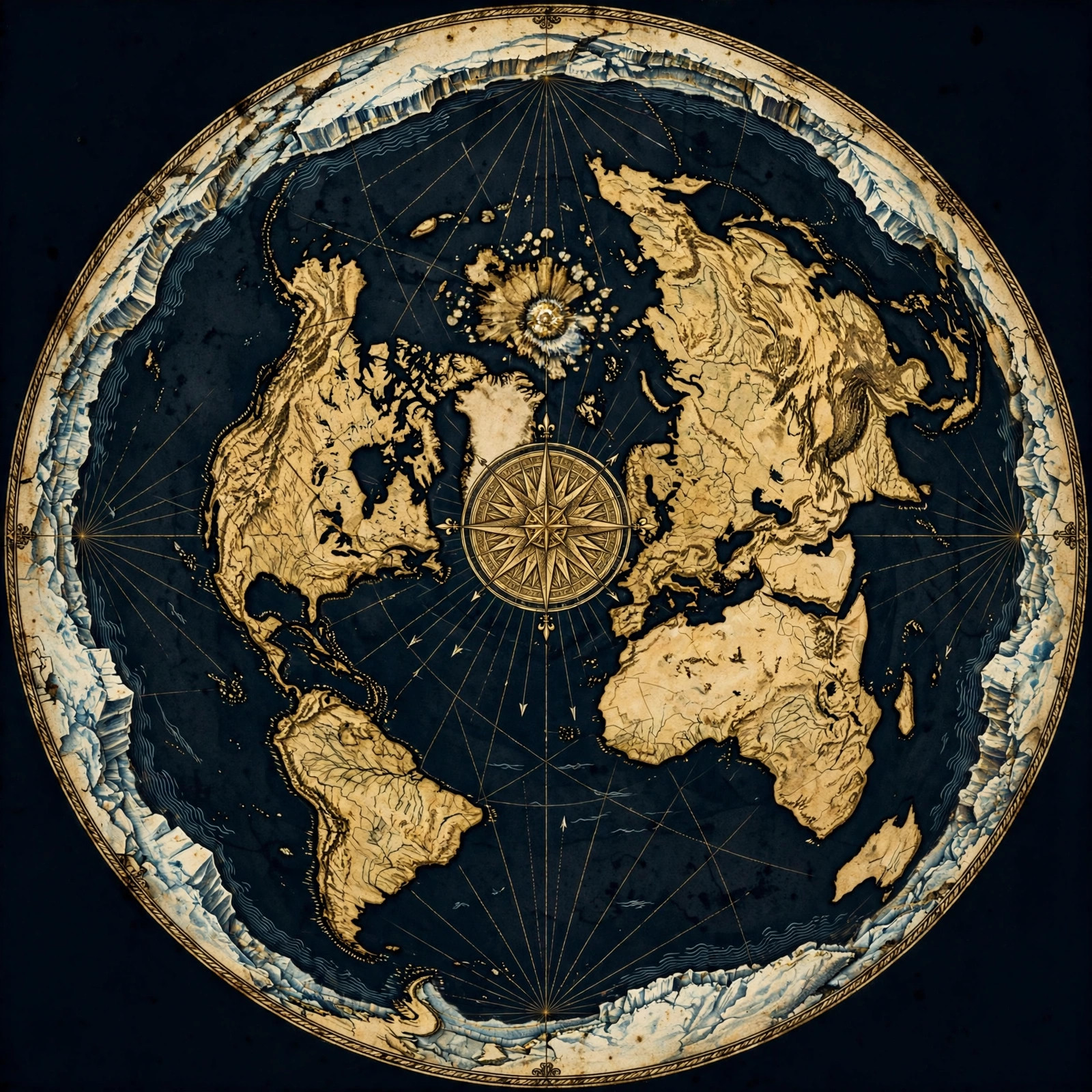
The Dome Above Our Heads
Look up. What do you see? A vast blue expanse by day, a starry canopy by night. But what if that expanse isn't an infinite void? What if it's a tangible boundary—a firmament? This isn't a new idea; it's one of the oldest descriptions of our world, found in Genesis and echoed in cultures across the globe. The firmament is the dome that separates the waters above from the waters below, a solid structure that the Globe Deception has tried to erase from our collective memory.
In this post, we'll explore what the firmament is, the evidence for it, and why acknowledging it changes everything. We'll question the assumptions of the globe model and rediscover the cosmos as our ancestors knew it. Remember: Question Everything.
What Is the Firmament?
The firmament is the solid dome described in Genesis as separating the waters above from the waters below. It is a physical boundary, not a metaphor, and its existence challenges the Globe Deception's claim of an infinite, heliocentric universe.
The word "firmament" comes from the Latin firmamentum, meaning a support or strengthening. In the Bible, Genesis 1:6-8 describes God creating a firmament to divide the waters: "And God said, Let there be a firmament in the midst of the waters, and let it divide the waters from the waters." This firmament is clearly presented as a solid expanse—a dome—that holds back the waters above.
This isn't unique to the Bible. The ancient Hebrews, Greeks, Egyptians, and many other cultures described the sky as a solid dome or vault. The idea of a literal firmament was common until the Globe Deception gradually replaced it with the idea of an infinite, unbounded space. But the evidence for a firmament is still with us—if we're willing to look.
For a deeper dive into the cosmology that includes the firmament, see our evidence page.
Evidence for a Solid Dome
The firmament is evidenced by phenomena like the firmament's reflective properties, the impossibility of crossing the Antarctic ice wall, and the failure of all globe-model experiments. These observations point to a bounded, enclosed system consistent with a solid dome.
How do we know the firmament is real? Start with the simplest observation: the sky is blue. Why? In the globe model, it's Rayleigh scattering. But a solid dome with water above it would also produce a blue color—and it would explain why the sky appears as a perfect backdrop, not a void.
Consider the stars. They move in perfect circles around the North Star, as if attached to a rotating dome. No parallax has ever been measured for stars beyond a certain distance—they behave like lights on a ceiling, not distant suns. The Globe Deception claims they are trillions of miles away, but the evidence suggests they are much closer, fixed to the firmament.
Then there's the Moon. It's been shown to be translucent, with stars visible through it. That's impossible if it's a solid rocky body. Instead, it fits the model of a light within the firmament.
For more on these evidences, see our compiled observations.
The Firmament in Scripture and History
The firmament is described in Genesis and other ancient texts as a solid dome. Historical cultures worldwide believed in a domed sky, and this view persisted until the Globe Deception gained prominence in the 16th century.
The Bible is explicit: the firmament is a solid expanse. In Job 37:18, we read that God "spread out the sky, which is strong, and as a molten looking glass." That's a mirror-like, solid surface. In Ezekiel 1:22, there's a "firmament like the colour of terrible crystal" above the living creatures. These aren't poetic metaphors; they describe a physical structure.
Ancient cultures from Egypt to China described a domed sky. The Egyptians had the goddess Nut arching over the earth; the Babylonians had a solid heaven; the Chinese believed in a spherical dome. The idea of a firmament was universal. It was only with the rise of heliocentrism that the firmament was reinterpreted as metaphorical or dismissed entirely.
Even today, many people instinctively think of the sky as a dome. We say "the heavens above" and "the four corners of the earth." These phrases reflect a cosmology that the Globe Deception has tried to suppress.
Firmament vs. The Globe Deception
The firmament model offers a coherent, observation-based cosmology, while the Globe Deception relies on unproven assumptions and fails to account for phenomena like the flat horizon and stationary Earth. The firmament is the logical alternative.
The Globe Deception posits an infinite universe with Earth as a tiny speck orbiting a star. But this model requires immense assumptions: that gravity holds everything together, that light can travel for billions of years, that the Earth spins at 1000 mph without us feeling it. None of these have been demonstrated.
The firmament model, by contrast, starts with what we can observe: a stationary Earth, a flat horizon, and a rotating dome of lights. It explains the seasons, the tides, and the eclipses without invoking invisible forces. It's a model that fits the evidence.
Moreover, the firmament provides a purpose: we are enclosed in a created order, not lost in a meaningless void. The Globe Deception strips away meaning; the firmament restores it.
To see how the firmament aligns with other flat-earth observations, visit our FAQ.
Implications of the Firmament
If the firmament is real, then the cosmos is not what we've been told. It means the Earth is the center of creation, not a random planet. It means the stars are not distant suns but lights set in the dome for signs and seasons. It means the waters above are real, and the possibility of a global flood is not a myth but a logical consequence of a dome that can open.
This understanding has profound implications for science, theology, and our daily lives. It calls us to reexamine everything we think we know about astronomy, geology, and history. It invites us to question the authorities who have perpetuated the Globe Deception.
For a broader look at flat-earth cosmology, check out our blog and consider supporting our work through the store.
How to Observe the Firmament
You don't need a rocket to see evidence of the firmament. Start with simple observations:
- Watch the stars over several hours. They rotate around Polaris, as if attached to a dome.
- Observe the Moon. Note how it appears translucent at times, and how its face is always the same.
- Look for the curvature of the dome in long-exposure photographs of the night sky.
- Notice that the horizon is always flat, no matter your altitude.
These observations are available to everyone. The firmament is not hidden; it's right above us. Many of these points are explored in more detail on our evidence page.
Embrace the Firmament
The firmament is more than a concept—it's the true structure of our world. The Globe Deception has obscured this truth for centuries, but the evidence is clear for those who seek it. By acknowledging the firmament, we reclaim a coherent, purposeful cosmology that honors observation and Scripture.
We encourage you to question everything, to look up, and to join us in spreading the truth. Visit our maps page to see the flat-earth layout, and explore our flights page for travel that makes sense on a flat plane. Together, we can restore the firmament to its rightful place in our understanding.
Get the Map and Verify It Yourself
🗺 GET THE TRUE MAP
Don't take our word for it — verify it yourself. These historic flat earth maps let you trace the evidence in this article with a ruler and see the truth firsthand.
As an Amazon Associate we earn from qualifying purchases. See also our Amazon Finds page for more research gear.
Frequently Asked Questions
Is the firmament mentioned in the Bible?
Yes, the firmament is described in Genesis 1:6-8 as a solid expanse created by God to divide the waters. Other passages like Job 37:18 and Ezekiel 1:22 also describe it as a strong, crystalline dome.
How can we see the firmament if it's solid?
The firmament is visible as the blue sky and the starry night. Its solid nature is inferred from the way celestial bodies move as if attached to a dome, and from the absence of stellar parallax beyond a certain distance.
What about the waters above the firmament?
The waters above are a real reservoir held back by the firmament. They are the source of rain and were released during the global flood. This model explains the water cycle without needing evaporation from oceans.
Does the firmament contradict modern astronomy?
Modern astronomy is based on the Globe Deception, which assumes an infinite universe. The firmament model is supported by observational evidence and is consistent with a literal reading of Scripture. It challenges the assumptions of modern astronomy.
How does the firmament fit with flat-earth beliefs?
The firmament is a central part of flat-earth cosmology. It provides the dome that encloses the flat earth, with the sun, moon, and stars moving within or on it. It is the logical conclusion of a flat, stationary earth.
Take Action: Spread the Truth About the Firmament
The firmament is not a fairy tale—it's the reality of our created world. The Globe Deception has kept this truth hidden for too long. Now it's your turn to question everything and share the evidence. Start by exploring our evidence page, then engage with our community. Together, we can restore the firmament to its rightful place in our understanding. Join us today!
JOIN THE DISCUSSION