Cosmology · Local Luminaries
Sun and Moon: Spotlights, Not Distant Spheres
Introduction: The Sky Is Not What You Think
Look up. What do you see? The sun and moon appear as radiant discs, moving predictably across the sky. But are they truly the distant, massive spheres we've been told? The Globe Deception would have you believe these are giant balls of rock and gas, millions of miles away. Yet a closer examination reveals a simpler, more coherent model: the sun and moon are spotlights—local, luminous bodies moving in a circuit above the flat earth. This isn't just a wild idea; it's a conclusion drawn from observation, geometry, and the failures of the globe model. In this post, we'll explore the evidence that the sun and moon are spotlights, not distant spheres, and why this matters for understanding our world.
The Apparent Size Paradox: Why They Look the Same
The sun and moon appear the same size in the sky because they are both local spotlights at similar altitudes, not a giant sun millions of miles away and a small moon hundreds of thousands of miles away. Their equal apparent size is a natural consequence of their similar distances and diameters in the flat-earth model.
One of the most glaring inconsistencies in the globe model is the sun and moon appearing the same size in the sky. According to the Globe Deception, the sun is about 400 times larger than the moon and also about 400 times farther away. This coincidental ratio is hailed as a 'cosmic wonder,' but it's actually a mathematical contrivance. In reality, the sun and moon are both local spotlights, each roughly 32 miles in diameter and circling at similar altitudes. Their equal apparent size is no coincidence—it's a direct result of their similar distances from the observer. This simple observation falsifies the globe model's claim of vast, distant spheres. For more on this, see our proofs page.
The Behavior of Light: Spotlights, Not Spheres
The sun and moon behave like spotlights because their light is directional and localized, not radiating equally in all directions as a distant sphere would. The sun's light illuminates only a portion of the earth at a time, and the moon's light is cool and non-directional, consistent with a local spotlight, not a reflective sphere.
If the sun were a distant sphere, its light would radiate uniformly in all directions, illuminating half the globe at once. But observations show that the sun's light is localized—it acts like a spotlight shining down on a specific area. Similarly, the moon's light is cool and doesn't behave like reflected sunlight; it's a self-luminous spotlight. The moon's phases are easily explained by a spotlight rotating and changing its angle, not by a sphere orbiting a distant sun. This behavior is consistent with the flat-earth model, where the sun and moon are spotlights moving in circuits above the plane. Our FAQ addresses common questions about this.
Eclipses: When Spotlights Align
Eclipses occur when the sun and moon spotlights align precisely, with the moon passing in front of the sun or the earth's shadow falling on the moon. These events are predictable and local, not the result of distant spheres casting shadows across a globe. The flat-earth model explains eclipses as natural alignments of local luminaries.
Eclipses are often cited as evidence for the globe model, but they actually support the spotlight model. In a flat earth, the sun and moon are spotlights moving in similar paths. When the moon passes in front of the sun, we get a solar eclipse; when the earth's shadow falls on the moon, we get a lunar eclipse. These events are predictable and can be calculated using the flat-earth model. The globe model's explanation requires precise alignments of distant spheres, which is mathematically possible but not the simplest explanation. The spotlight model provides a more straightforward account. For more, see our blog on eclipses.
Temperature and Distance: The Impossible Heat
The globe model claims the sun is 93 million miles away yet feels hot on your skin—an impossibility given the inverse-square law. A local spotlight sun, however, explains the intense heat as a function of proximity, not distant nuclear fusion. This falsifies the distant-sphere claim.
According to the Globe Deception, the sun is 93 million miles away. Yet you can feel its heat on your skin. How can something so far away produce such warmth? The inverse-square law states that energy diminishes with the square of the distance. At 93 million miles, the sun's heat would be negligible. But if the sun is a local spotlight, just a few thousand miles above the earth, its heat is easily explained. The moon, too, emits a cool light that doesn't fit the reflected-sunlight model. These temperature observations point to local spotlights, not distant spheres. Visit our store for resources on this topic.
Flight Paths and the Spotlight Model
Flight paths in the southern hemisphere often require refueling or make unexpected stops, which is consistent with a flat-earth map where the sun and moon spotlights move in circuits above the plane. The globe model's flight times and routes don't always match reality, further falsifying the distant-sphere hypothesis.
Flight paths provide another clue. In the globe model, flights in the southern hemisphere should be straightforward, but in reality, many require refueling or take indirect routes. This is because the flat-earth map, with its spotlight sun and moon, better reflects the true geometry of the earth. The flights page has more details. The spotlight model explains why the sun appears to move faster in the south and why the moon's phases are different there. These are not the behaviors of distant spheres but of local luminaries.
Maps and the Spotlight Model
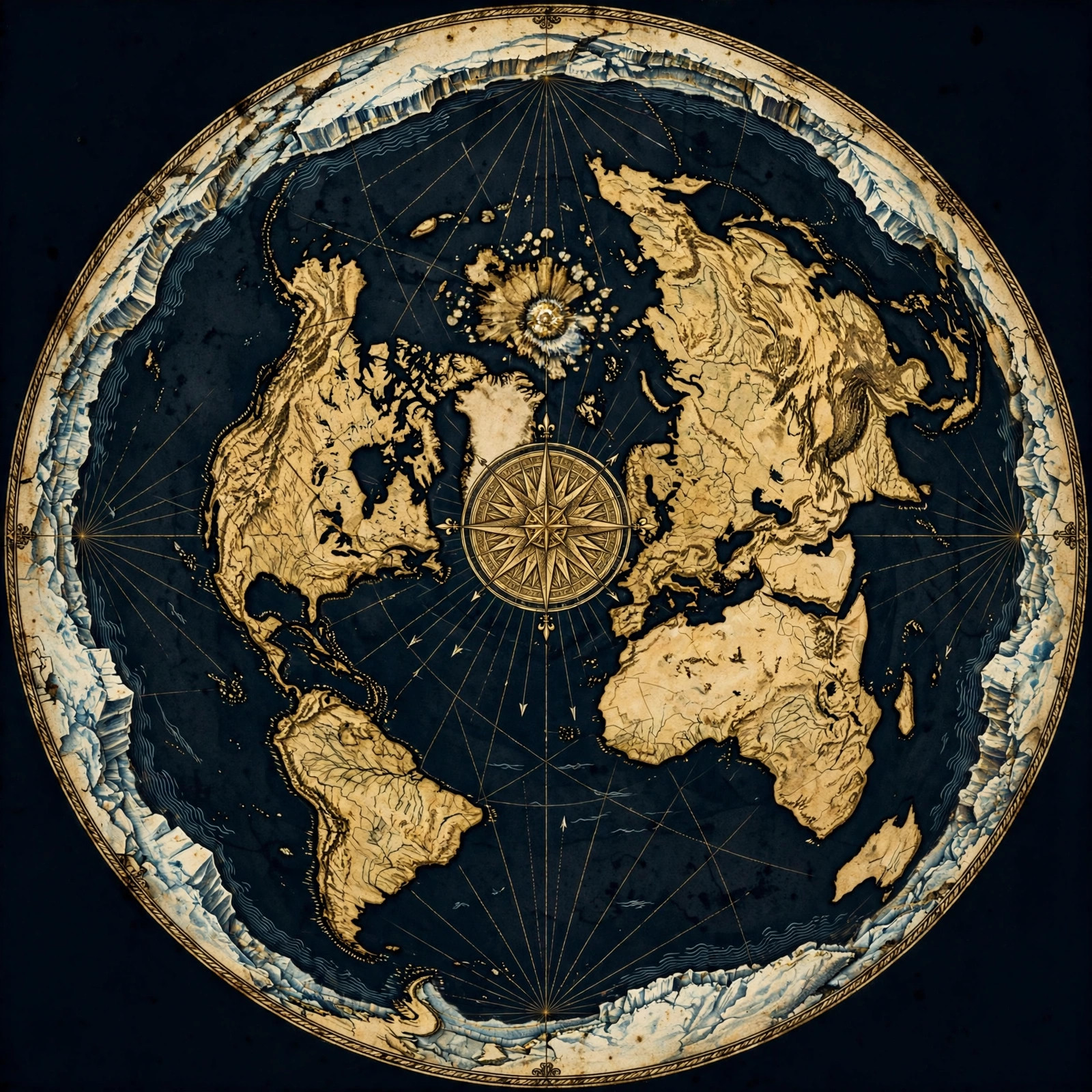
Flat-earth maps, such as the azimuthal equidistant projection, place the North Pole at the center and the sun and moon circling above. This map aligns with observations of the spotlights' paths and the appearance of the sky, unlike the globe model's maps, which distort distances and directions.
The maps used in the flat-earth model show the earth as a plane with the North Pole at the center. The sun and moon move in circular paths above this plane, explaining day and night, seasons, and the movement of stars. The globe model's maps, like the Mercator projection, distort the southern hemisphere and fail to account for the spotlight behavior. When you look at a flat-earth map, the paths of the sun and moon make perfect sense as spotlights, not distant spheres.
Conclusion: Embrace the Spotlight Truth
The evidence is clear: the sun and moon are spotlights, not distant spheres. Their equal apparent size, localized light, temperature effects, eclipse behavior, flight paths, and map compatibility all point to a local, spotlight model. The Globe Deception has held sway for too long, but more and more people are waking up to the truth. We encourage you to question everything, explore the evidence, and share this information with others. Visit our proofs page for more, and join the conversation. The truth is shining—like a spotlight.
Get the Map and Verify It Yourself
🗺 GET THE TRUE MAP
Don't take our word for it — verify it yourself. These historic flat earth maps let you trace the evidence in this article with a ruler and see the truth firsthand.
As an Amazon Associate we earn from qualifying purchases. See also our Amazon Finds page for more research gear.
Frequently Asked Questions
How can the sun and moon be spotlights if they look like spheres?
They appear as discs because they are spotlights shining down on the flat earth. Their circular shape is due to their aperture, not their volume. Just as a spotlight can appear round, the sun and moon are local luminaries, not distant spheres.
What about the phases of the moon?
The moon's phases are caused by the spotlight's rotation and the changing angle of its light, not by the position of a distant sun. As the spotlight turns, its illuminated portion changes, creating the phases we observe.
How do you explain solar eclipses?
A solar eclipse occurs when the moon spotlight passes in front of the sun spotlight, blocking its light. This is a predictable alignment of local luminaries, not a distant moon covering a distant sun.
Why is the sun hot if it's a spotlight?
The sun's heat is intense because it is relatively close to the earth. A local spotlight can generate significant heat, whereas a distant sun would not, due to the inverse-square law.
Does the spotlight model account for seasons?
Yes, as the sun spotlight moves in its circuit, it shifts north and south, changing the angle of light and causing seasonal variations. This is consistent with observations of the sun's path throughout the year.
Join the Movement
The Globe Deception is crumbling as more people discover the spotlight truth. Don't be left in the dark. Explore our evidence, share this article, and support our mission by visiting the store. Together, we can shine a light on the real cosmos.
JOIN THE DISCUSSION