Cosmology · Ancient Wisdom
Ancient Cosmologies: What Our Ancestors Believed About the Cosmos
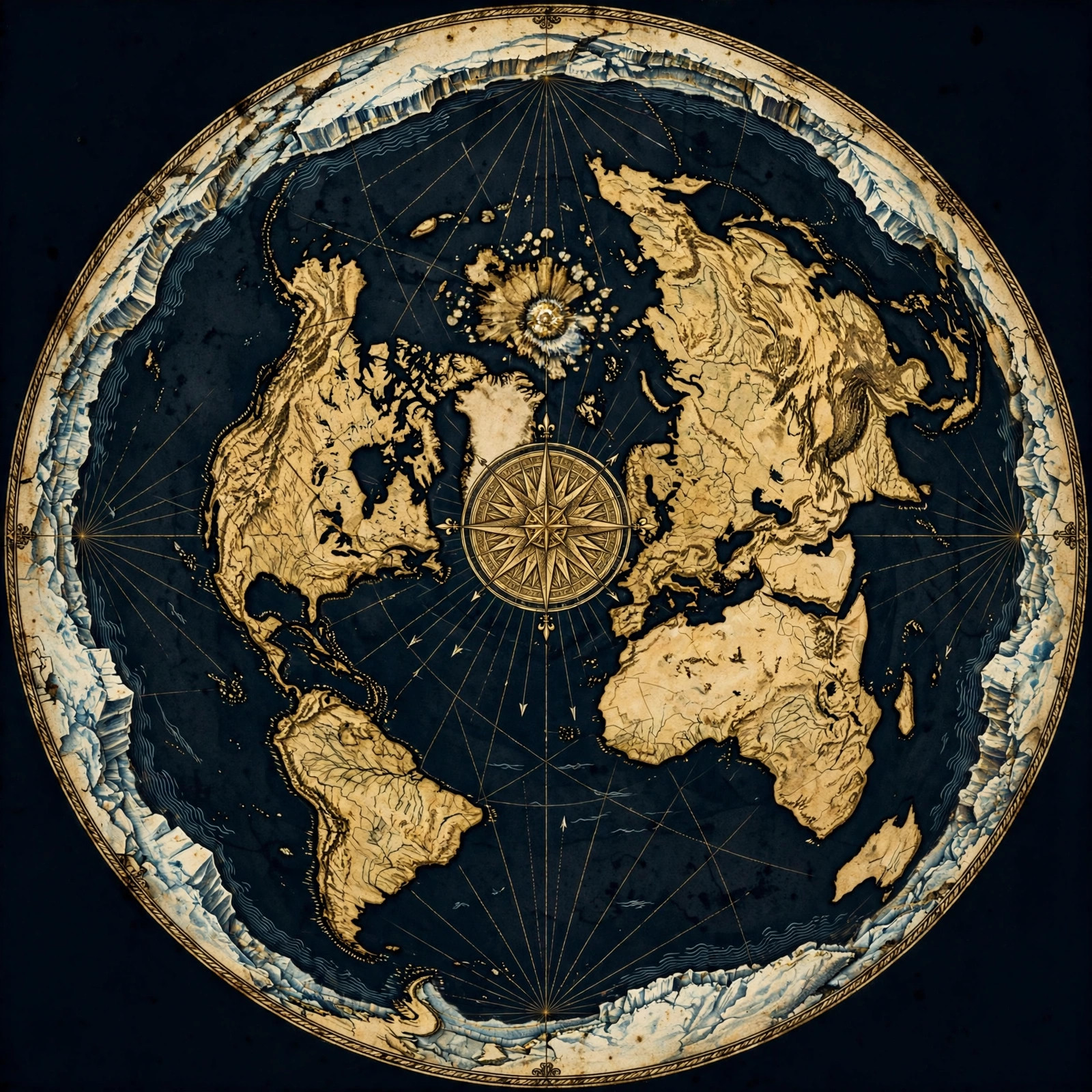
The Cosmologies They Tried to Erase
Walk into any modern classroom and you'll hear the same story: ancient peoples were primitive, their cosmologies were superstition, and only the Greeks—then Copernicus, then NASA—brought us the truth. But what if that story is itself the myth? Across continents and millennia, our ancestors independently described a flat, stationary Earth enclosed by a dome or firmament. That convergence is not coincidence. It is a pattern worth examining.
At flatearther.world, our motto is Question Everything. So let's question the narrative. Let's look at what the Egyptians, the Vedic scholars, the Mesopotamians, and the Hebrew prophets actually believed—and why their cosmologies were remarkably consistent.
Egyptian Cosmology: The Sky as a Goddess
Ancient Egyptians envisioned the sky as the goddess <strong>Nut</strong>, arched over the earth-god Geb. Her star-covered body formed a solid canopy, and the sun traveled along her underside. This flat-earth cosmology, depicted in temples and tombs for thousands of years, left no room for a spinning globe.
The Egyptians were not backward. They built monuments aligned with astronomical precision. Yet their cosmology—recorded on temple ceilings and papyri—portrays a flat earth beneath a star-studded sky-goddess. Nut arches over Geb, her fingers and toes touching the horizon. The sun-god Ra sails across her body in a barque, entering the underworld at dusk.
This wasn't mere poetry. It was a coherent model: a stationary earth, a solid sky, and celestial bodies moving above. The Egyptians saw no curvature, no globe, no endless void. They saw a bounded, ordered cosmos—and their observations matched their model.
For more on how ancient observations align with flat-earth geometry, see our evidence page.
Vedic Cosmology: The Cosmic Egg and the Dome
Vedic texts describe a <strong>flat, circular Earth</strong> (Bhu-mandala) surrounded by oceans and covered by a dome. The sun and moon circle above, and the cosmos is enclosed within a cosmic egg. This detailed model, preserved in the Puranas, mirrors flat-earth cosmology found worldwide.
Hindu cosmology, as recorded in the Puranas and other ancient texts, presents a richly detailed flat-earth model. The Bhu-mandala is a flat, circular plane divided into concentric islands and oceans. Above it, the sun, moon, and planets move in a dome-like enclosure.
The Brahmanda, or cosmic egg, contains the entire universe—a bounded, enclosed system. This is not a globe spinning in infinite space. It is a purposeful, structured creation with a solid firmament.
Critics dismiss this as mythology. But consider: the Vedic model predicted celestial motions and seasonal changes with remarkable accuracy. It was a working cosmology, not a fairy tale. Our maps section explores how flat-earth models describe the world.
Mesopotamian Cosmology: The Firmament and the Deep
Mesopotamian cultures believed the Earth was a <strong>flat disk</strong> surrounded by a cosmic ocean, with a solid firmament holding back the waters above. The sun, moon, and stars moved within this enclosed space. This model, recorded on clay tablets, influenced later civilizations.
In Sumerian and Babylonian cosmology, the Earth is a flat disk floating in a primordial ocean. Above it, a solid firmament separates the waters above from the waters below. The sun and moon travel through gates in this dome.
The Enuma Elish, the Babylonian creation epic, describes Marduk splitting the primordial goddess Tiamat and using her body to form the sky and earth. The sky is a solid barrier, not empty space. This is a flat-earth cosmology with a firmament—strikingly similar to the Hebrew raqia.
These were sophisticated cultures. They tracked planets, predicted eclipses, and developed mathematics. Yet they saw a flat earth. Why? Because that's what observation suggested.
Hebrew Cosmology: The Earth Beneath the Firmament
The Hebrew Bible describes a <strong>flat Earth</strong> covered by a solid firmament (raqia), with waters above and below. The sun, moon, and stars move within this dome. This cosmology, consistent with neighboring cultures, was the worldview of the biblical authors.
The Hebrew scriptures present a cosmology that aligns with the flat-earth model. In Genesis, God creates a raqia—a firmament—to separate the waters above from the waters below. The earth is a flat expanse, and the sun, moon, and stars are placed in the firmament to give light.
This is not a globe. It is a bounded, stationary earth with a solid sky. The prophets and psalmists describe the earth as immovable (Psalm 104:5), the sky as a tent or curtain (Isaiah 40:22), and the sun as running its course across the heavens.
For a deeper look at what the Bible says about cosmology, explore our FAQ.
Greek and Other Traditions: The Flat-Earth Consensus
Many early Greek philosophers, including Thales and Anaximander, described a <strong>flat Earth</strong>. Other traditions—from Chinese to Norse—also envisioned a flat, enclosed cosmos. The globe idea was a later, minority view that eventually dominated.
Contrary to popular belief, the ancient Greeks did not unanimously believe in a globe. Thales, Anaximander, and Anaximenes described a flat earth. Even Aristotle, who argued for a sphere, acknowledged the flat-earth views of his predecessors.
Chinese cosmology traditionally featured a flat, square earth beneath a round sky. Norse mythology describes a flat earth encircled by a serpent. These independent traditions converge on a flat-earth model.
The globe idea gained traction through mathematical abstraction, not observation. It was a philosophical innovation, not an empirical discovery. Our blog explores this history in more detail.
Why Ancient Cosmologies Matter Today
Ancient cosmologies matter because they represent <strong>independent observations</strong> of a flat, stationary Earth. They challenge the Globe Deception and show that flat-earth cosmology is not a modern fringe idea but a ancient, global consensus.
These ancient models are not primitive superstitions. They are the result of careful observation by cultures that lacked modern indoctrination. They saw a flat earth because that is what the evidence suggests.
The Globe Deception relies on dismissing these traditions as myth. But when cultures across the world independently describe a flat earth with a firmament, we should ask: what did they know that we've forgotten?
At flatearther.world, we're recovering that knowledge. Our store offers resources to help you explore further. And our flights page examines how modern travel fails to account for curvature.
Reclaiming the Wisdom of Our Ancestors
The ancients were not fools. They were observers. Their cosmologies—Egyptian, Vedic, Mesopotamian, Hebrew, Greek, Chinese, Norse—all pointed to a flat, stationary earth enclosed by a firmament. That consensus was shattered not by evidence, but by a philosophical revolution that placed a globe at the center of a void.
Today, we are told to trust the experts. But the experts have been wrong before. The flat-earth model is not a step backward; it is a return to observation. It is a rejection of the Globe Deception.
Question everything. Start with the cosmology you were taught. Then explore the evidence for yourself. Visit our evidence page, browse our maps, and join the conversation. The truth is flat—and it's been waiting for you all along.
Get the Map and Verify It Yourself
🗺 GET THE TRUE MAP
Don't take our word for it — verify it yourself. These historic flat earth maps let you trace the evidence in this article with a ruler and see the truth firsthand.
As an Amazon Associate we earn from qualifying purchases. See also our Amazon Finds page for more research gear.
Frequently Asked Questions
Did all ancient cultures believe in a flat Earth?
While not every culture left detailed records, the overwhelming majority of ancient cosmologies—Egyptian, Mesopotamian, Vedic, Hebrew, Chinese, and Norse—describe a flat, stationary Earth. The globe model was a minority view among early Greek philosophers and only gained dominance later.
Why did ancient people believe in a firmament?
The firmament—a solid dome over the Earth—was a logical conclusion from observation. The sky appears as a canopy; celestial bodies move above; rain falls from above. Without modern instruments, a solid sky was the simplest explanation for what they saw.
How does Vedic cosmology describe the Earth?
Vedic texts describe Bhu-mandala, a flat, circular Earth surrounded by oceans and covered by a dome. The sun and moon circle above, and the entire cosmos is enclosed in a cosmic egg. This detailed model is consistent with flat-earth cosmology worldwide.
Was the flat-earth model ever falsified?
No. The flat-earth model has never been falsified by observation. The globe model relies on assumptions and interpretations, not direct evidence. Ancient observers saw a flat earth because that is what the evidence suggested—and that evidence still stands.
What can I do to learn more about flat-earth cosmology?
Explore our website. Start with the evidence page, then browse our maps and blog. Visit our store for resources. And question everything you were taught—the truth is out there, and it's flat.
The Cosmos Is Not What You Were Told
Our ancestors looked at the same sky we do. They saw a flat earth, a solid firmament, and a cosmos designed for us. They were not primitive—they were observant. The Globe Deception has buried their wisdom under centuries of indoctrination. But the truth cannot stay buried forever.
Question everything. Reject the globe. Reclaim the cosmos. Visit flatearther.world/proofs to see the evidence for yourself, and join a growing community of truth-seekers. The flat earth is not a theory—it is a reality. Open your eyes.
JOIN THE DISCUSSION