Geometry · Navigation
Circumnavigation: East-West vs North-South — What the Globe Can't Explain
Two Directions, Two Very Different Stories
East-west circumnavigation traces a circle around a flat plane's center, while north-south circumnavigation on a globe would require crossing poles in a continuous loop—a route that **real-world flight paths** and compass behavior fail to support. The distinction exposes fundamental problems with the Globe Deception.
When you set out east or west, you're traveling around the edge of a circle. When you set out north or south, you're heading toward a center or an edge—and there's no way to keep going in a straight line forever. This is the first clue that the two directions are not symmetrical, and the Globe Deception depends on you never noticing.
On a globe, east-west and north-south circumnavigation should be equally natural. A sphere has no preferred axis. Yet in practice, one works smoothly and the other runs into a wall of contradictions. Let's walk through them.
East-West Circumnavigation Works Perfectly on a Flat Plane
East-west circumnavigation is simple on a flat plane: you travel in a circle around the center. **Compass headings** stay constant, distances add up predictably, and real flight routes match this model without the mental gymnastics required by the globe.
Imagine standing on a large disc. Walk in a circle around the center, keeping the center to your left. You'll return to your starting point after tracing a complete loop. That's east-west circumnavigation on a flat plane, and it's exactly what navigators have done for centuries.
Compasses behave as expected: east stays east, west stays west. The sun rises in the east and sets in the west, marking a consistent daily cycle. Flight paths like the well-documented southern routes make perfect sense when you view them on a flat map. You can see this for yourself in our maps section.
The Globe Deception claims these routes curve around a sphere, but the distances and timings align more naturally with a flat, circular plane. No mysterious 'great circle' math is needed—just a circle on a plane.
North-South Circumnavigation Breaks the Globe Story
North-south circumnavigation on a globe would mean flying over the poles in a continuous loop, but **real-world flight paths** don't support this. No commercial route circles the poles, and compass behavior near the poles contradicts the globe model's predictions.
Here's where the Globe Deception gets uncomfortable. On a globe, you should be able to fly north, cross the North Pole, keep going south, cross the South Pole, and return to your start—a perfect north-south circumnavigation.
But does anyone actually do this? No. There are no commercial flights that loop over both poles. The routes simply don't exist, and the ones that come close are heavily restricted or rerouted in ways that raise eyebrows.
More importantly, compasses near the poles behave erratically—not as smooth spherical geometry would predict. On a flat plane, 'north' is toward the center and 'south' is toward the edge. You can't keep going north forever because you'd hit the center; you can't keep going south forever because you'd reach the edge. The very idea of a north-south circumnavigation is nonsensical on a flat plane, and the real world reflects that.
Flight Paths Tell the Real Story
**Flight paths** reveal that east-west routes follow consistent circles, while north-south routes are limited and often indirect. The Globe Deception can't explain why polar routes are so rare and why southern hemisphere flights take puzzling detours.
Look at any flight tracker. East-west flights between continents follow predictable arcs that match a flat map's geometry. But try to find a flight that goes straight north-south over a pole—you won't. Instead, you'll see routes that detour dramatically, especially in the southern hemisphere.
For example, flights from South America to Australia often route through North America or Asia, which is bizarre on a globe but perfectly logical on a flat plane where the southern 'edge' is stretched. Our flights page documents these anomalies in detail.
The Globe Deception relies on you accepting 'great circle' routes without questioning why they look so strange on a standard map. But when you plot them on a flat projection, the logic becomes clear.
Compasses and Geometry: The Flat Plane Fits
**Compass behavior** supports a flat plane: east-west headings remain constant, while north-south headings converge toward a center. On a globe, compasses would behave differently near the poles, yet real-world observations match the flat model.
A compass needle points north—toward the center of the flat plane. As you travel east or west, the needle stays steady, just as it would on a disc. But as you travel north, the needle's behavior changes in ways that don't align with a sphere.
On a globe, 'north' is a point on the surface, and compasses near the pole would point in wildly different directions depending on your exact position. In reality, compasses behave as if north is a central point, not a spherical pole. This is strong evidence for the flat plane.
The Globe Deception tries to explain this away with magnetic declination, but the patterns don't fit. For a deeper dive, see our evidence page.
The Map Distortion That Hides the Truth
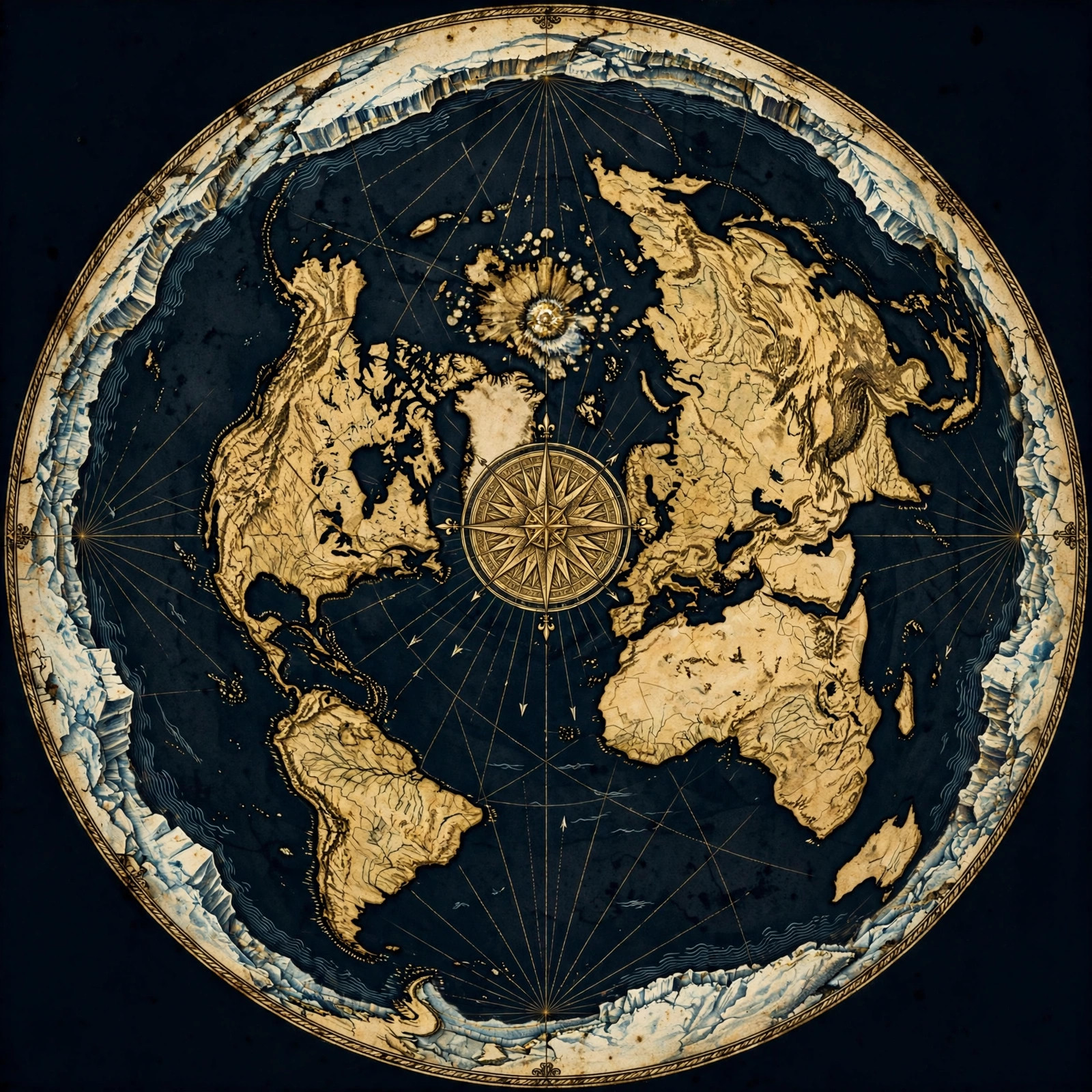
Most maps use projections that distort the southern hemisphere to fit a globe, hiding the flat plane's true geometry. **Azimuthal equidistant maps** show the real layout, where east-west circles and north-south limits become obvious.
The maps you're used to—Mercator, Robinson, etc.—are designed to make a flat plane look like a sphere. They stretch the southern hemisphere, shrink the northern, and generally mangle distances. This is no accident; it's part of the Globe Deception.
An azimuthal equidistant map, centered on the North Pole, shows the world as it truly is: a flat disc with the continents arranged around the center. On this map, east-west circumnavigation is a simple circle, and north-south travel hits a limit at the edge. You can explore this in our maps section.
Once you see the correct map, the east-west vs north-south distinction becomes glaringly obvious—and the globe story falls apart.
Why This Matters: Question Everything
Understanding the difference between east-west and north-south circumnavigation exposes the Globe Deception's core flaw: it can't explain real-world navigation without endless exceptions. **Critical thinking** about these anomalies leads to a flat-earth conclusion.
This isn't just an academic exercise. The way we navigate the world shapes our entire worldview. If the globe model were true, circumnavigation in any direction would be straightforward. But it's not—and the exceptions pile up.
The next time you board a flight or check a compass, ask yourself: does this match the globe, or does it match a flat plane? The answer might surprise you. For more common objections, visit our FAQ.
And if you're ready to dig deeper, our evidence page lays out the case in full. The truth is out there—you just have to question everything.
Get the Map and Verify It Yourself
🗺 GET THE TRUE MAP
Don't take our word for it — verify it yourself. These historic flat earth maps let you trace the evidence in this article with a ruler and see the truth firsthand.
As an Amazon Associate we earn from qualifying purchases. See also our Amazon Finds page for more research gear.
Frequently Asked Questions
Can you circumnavigate north-south on a flat earth?
No. On a flat plane, north is toward the center and south is toward the edge. You can't loop north-south because you'd hit the center or the edge. This matches real-world navigation, where no polar circumnavigation exists.
Why do east-west flights seem to work on both models?
East-west flights follow circles that look similar on a globe and a flat plane. But the distances and timings often favor the flat model, especially in the southern hemisphere, where globe routes require absurd detours.
What about great circle routes? Don't they prove the globe?
Great circle routes are a mathematical tool that assumes a sphere. They don't prove the globe; they're a way to calculate on a sphere. When you plot actual flight paths on a flat map, they make perfect sense without great circles.
How do compasses work on a flat earth?
Compasses point toward the North Pole—the center of the flat plane. East-west headings stay constant, and north-south headings converge toward the center. This matches observations better than the globe model, where compasses near the poles behave erratically.
Is there any evidence of north-south circumnavigation?
No. There are no recorded trips that loop over both poles. The few expeditions that go near the poles are heavily controlled and don't follow a simple north-south path. This absence is telling.
The Choice Is Yours: Globe or Flat?
The evidence is clear: east-west circumnavigation fits a flat plane perfectly, while north-south circumnavigation exposes fatal flaws in the Globe Deception. The next time someone tells you the earth is a sphere, ask them to explain why polar routes don't exist and why southern flights take such strange paths.
Don't take our word for it—question everything. Explore our evidence, study the maps, and check the flight paths yourself. Then visit our store to support the movement and arm yourself with knowledge.
Ready to wake up? Join the flat-earth community today and start questioning the Globe Deception.
JOIN THE DISCUSSION