Space Program · Question Everything
NASA Anomalies and Inconsistencies: Cracks in the Globe Deception
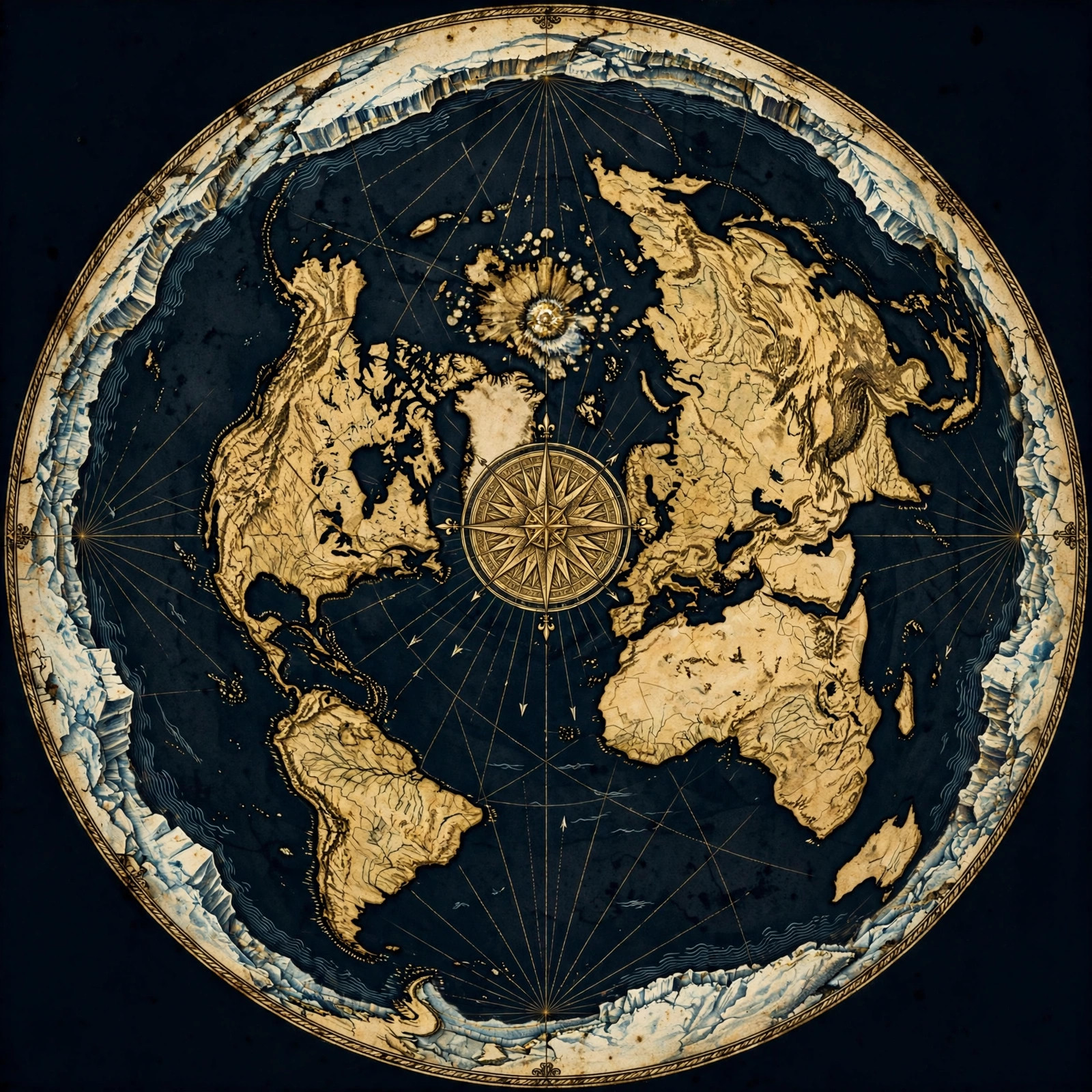
Why NASA's Anomalies Matter
NASA anomalies matter because an honest space program should not be full of contradictions. When **official records** conflict with themselves, a reasonable person should question the story rather than the questioner.
Every organization makes mistakes. But there is a difference between an occasional clerical error and a pattern of contradictions that always seem to protect the same narrative. When you look closely at NASA's public record, the second pattern is what emerges.
This is not about disliking scientists or hating space. It is about applying the same standard of scrutiny to the official narrative that skeptics are asked to apply to everything else. If the globe model were as solid as we are told, its flagship agency should welcome hard questions. Instead, the questions tend to get deflected, mocked, or quietly ignored.
What follows is a tour through the inconsistencies that keep resurfacing: the radiation belts, the footage, the money, the missing technology, and the strange reluctance to simply show us the curve. If any of this is new to you, start with our collection of falsifications and then come back here for the NASA-specific angles.
The Van Allen Belts: A Barrier Nobody Explains
The Van Allen radiation belts are intense zones of charged particles around Earth. NASA's own descriptions call them hazardous, yet the Apollo missions supposedly passed through them with **minimal shielding** and no reported harm, a contradiction that has never been satisfyingly addressed.
Ask NASA what the Van Allen belts are and you will hear about dangerous regions of energetic particles trapped by Earth's magnetic field. Ask how Apollo astronauts crossed them in 1968 with thin hulls and no reported radiation sickness, and the answers get vague fast: a clever trajectory, a quick transit, 'it was fine.'
Here is the inconsistency in plain terms. The same agency that describes the belts as a serious hazard for satellites and crewed operations also claims that men in a capsule skimmed through them repeatedly, on multiple missions, with no shielding worth mentioning and no health consequences. Either the belts are dangerous or they are not. The story cannot have it both ways depending on which question is being asked.
Meanwhile, modern crewed programs in low orbit are carefully kept below the worst of the belts. If the region were a minor nuisance, why the caution now? The hazard language used in NASA's own materials sits awkwardly beside the breezy confidence of the Apollo era. For more on how the globe model's physical claims keep collapsing under scrutiny, see our falsified claims archive.
Footage, Photos, and the Studio Question
NASA's imagery has repeatedly contained anomalies that resemble **studio conditions**: inconsistent shadows, missing stars, flag movement without wind, and footage that has been edited or re-released in altered versions.
Photographs and film are supposed to be the strongest evidence for the space story. Instead, they are a goldmine of oddities.
- Shadows that fall in different directions within a single frame.
- Backdrops that look suspiciously like painted curtains or matte paintings.
- Flags that ripple in a vacuum where no wind exists.
- Starless skies in photos where stars should be abundant.
- Footage that appears in multiple versions, sometimes with elements added or removed.
Each item alone can be waved away with a technical explanation. Together, they form a pattern that looks less like photography in a vacuum and more like controlled production. The 'studio question' is not a joke; it is the natural conclusion when imagery keeps behaving like a set rather than a spacecraft.
And notice the asymmetry: when a skeptic points out an anomaly, the burden of explanation lands on the skeptic. When NASA releases an altered or contradictory image, the correction is treated as routine housekeeping. That double standard is exactly what the motto 'Question Everything' is designed to cut through.
The Money and the Paperwork
NASA's budget and accounting have long been criticized in audits, with **cost overruns** and loose tracking. Billions flow through layers of contractors, and the public rarely sees a clean line from tax dollars to results.
Follow the money. NASA receives billions of dollars every year, much of it routed through a sprawling network of contractors and subcontractors. Independent audits have repeatedly flagged poor cost tracking, schedule slips, and projects that balloon far beyond their original estimates.
This matters for a simple reason: an agency that struggles to account for its money should not be granted unlimited credibility about its achievements. The paper trail is messy, and the public is asked to accept the headlines while the accounting stays opaque.
There is also the question of incentive. A space agency's funding depends on the public believing in the grand story. When the story is questioned, the funding is threatened. That is not a conspiracy theory; that is basic institutional self-interest, and it should make any honest observer at least a little suspicious.
The Lost Technology Problem
NASA claims it once sent crews to the Moon with computing power far below a modern phone, yet says it **cannot rebuild** that capability today. Either the original achievement was exaggerated or the agency is not being straight about what it can do.
Here is one of the strangest inconsistencies of all. We are told that in the late 1960s, with computers less powerful than a pocket calculator, NASA sent men to the Moon and back multiple times. Today, with vastly superior technology, the agency says recreating that capability would be enormously difficult and expensive.
How does a civilization lose a technology it supposedly mastered over fifty years ago? Real engineering knowledge is documented, tested, and passed on. If the Apollo hardware was genuinely built and flown, the designs, tooling, and expertise should have been preserved or improved upon, not misplaced.
The most reasonable reading is that the capability gap reveals something deeper: the story of the 1960s is not what we have been told. When an institution claims a past triumph it cannot reproduce, skepticism is not cynicism. It is basic reasoning.
The Curve That Never Gets Shown
Despite thousands of satellites and countless cameras, no ordinary, unedited photograph clearly shows Earth's **curvature** from the surface. The images we do get are composites, wide-angle distortions, or heavily processed.
If Earth is a globe, the curve should be one of the easiest things in the world to demonstrate. Send up a balloon with a camera, point it at the horizon, and show the curve. Yet the images we receive are almost always composites, stitched panoramas, or ultra-wide lenses that manufacture curvature through distortion.
Ask for a single raw, unedited, time-stamped photograph showing the horizon curving the way the model requires, and the request tends to go unanswered. This is the quiet anomaly at the heart of the whole debate: the simplest demonstration is the one that never arrives.
Our maps and models section lays out what a flat, level Earth actually predicts and how those predictions keep matching observation. If you want the short version of the biggest questions, the FAQ is a good starting point.
Questions Worth Asking
None of these anomalies require a grand conspiracy to notice. They require only the willingness to look at the record and ask why it does not line up with itself. That is the whole method here at flatearther.world: Question Everything, including the institutions that tell us what the sky is.
If you have read this far, you are already doing what most people never do. Keep going. Read the blog archive for more deep dives, check the flight-path observations that the globe model struggles to explain, and browse the store if you want to support independent research.
Get the Map and Verify It Yourself
🗺 GET THE TRUE MAP
Don't take our word for it — verify it yourself. These historic flat earth maps let you trace the evidence in this article with a ruler and see the truth firsthand.
As an Amazon Associate we earn from qualifying purchases. See also our Amazon Finds page for more research gear.
Frequently Asked Questions
Are NASA anomalies just editing mistakes?
Some may be. But the pattern matters more than any single frame. When the same kinds of oddities recur across decades of imagery, footage, and official statements, the reasonable conclusion is not 'careless editing' but a narrative being managed. Mistakes happen; patterns reveal intent or at least a system protecting itself.
Why would NASA hide the shape of Earth?
Institutions protect funding, prestige, and control of the narrative. A flat, level Earth changes the story of our place in the universe and undermines the authority built on the globe model. Whether the motive is money, power, or ideology, the incentive to maintain the Globe Deception is enormous and obvious.
What about all the independent space programs?
Other agencies repeat the same story because they operate inside the same framework and share the same funding structures and reputational stakes. Independence is often claimed but rarely real when every program depends on the same assumptions and the same public credulity.
Can I see these anomalies myself?
Yes. Look at official NASA imagery and check shadows, star fields, and horizon lines. Compare versions of the same footage. Read the audits. You do not need special access, only patience and the habit of asking why the record keeps contradicting itself.
Where should I start learning more?
Start with our proofs section for the core falsifications, then the maps section to see what a flat Earth actually predicts. The FAQ answers common objections, and the blog archive has deeper dives into NASA's record and the Globe Deception.
Stop Trusting, Start Testing
The anomalies are there for anyone willing to look. NASA's own words, images, budgets, and admissions form a record full of contradictions that the Globe Deception cannot smooth over. You do not need permission to notice them.
So do something with what you have read. Share this article with someone who still trusts the headlines. Visit our falsifications archive and work through the evidence yourself. Browse the store to support the work. And above all, keep asking the question that makes institutions nervous: Question Everything.
JOIN THE DISCUSSION