Astronomy · Solar Motion
The Sun's Spiral Path and the Hotspots: A Flat-Earth View of Light and Heat
Introduction: Questioning the Sun's Path
If you've ever watched a sunrise or felt the midday heat, you've participated in one of the oldest observations known to humanity. Yet the standard explanation—a spinning globe hurtling around a massive star—leaves many questions unanswered. At flatearther.world, we question everything. And when it comes to the sun's motion and the distribution of heat across our world, the flat-earth model offers a surprisingly coherent picture.
In this post, we'll explore the sun's spiral path and how it creates the hotspots we experience daily. We'll see why the Globe Deception struggles to account for these patterns, and how a simple, observation-based model makes sense of them.
What Is the Sun's Spiral Path?
The **sun's spiral path** is its annual journey between the tropics of Cancer and Capricorn, moving in a tightening and widening spiral over the flat plane. This motion brings the sun closer to the North Pole in summer and farther in winter, creating seasonal changes.
In the flat-earth model, the sun is a relatively small, local body that circles above the plane of the earth. Its path is not a perfect circle but a spiral. Each day, the sun completes one circuit, but its radius shifts gradually over the course of a year.
During the northern summer, the sun's spiral tightens, bringing it closer to the center—the North Pole. During the northern winter, the spiral widens, taking the sun farther out toward the edge. This annual oscillation is what we call the sun's spiral path.
This model directly explains why the sun rises and sets at different points on the horizon throughout the year. It also accounts for the midnight sun in the Arctic and the long days of summer. The spiral is not an abstract concept; it's a description of what we actually observe.
How the Spiral Creates Hotspots
**Hotspots** are regions of intense heat that shift with the sun's spiral. As the sun moves closer to a given latitude, that area experiences greater direct exposure, creating localized temperature peaks. The tropics are the most consistent hotspots because the sun's spiral keeps them in near-constant focus.
If you've ever noticed that some places are consistently hotter than others—even at the same latitude—you're seeing the effect of the sun's spiral on a local scale. The spiral path means the sun's energy is not evenly distributed. It concentrates along the path it traces, much like a magnifying glass moving across a surface.
Consider the equator. In the flat-earth model, the equator is a circle midway between the center and the edge. The sun's spiral crosses this region twice a year, but even when it's at its widest, the equator remains relatively close. This is why tropical regions are hotspots year-round.
But hotspots aren't just about latitude. The spiral's changing radius means that the sun's angle and distance vary in complex ways. Mountain ranges, ocean currents, and atmospheric conditions all interact with this moving heat source. The result is a dynamic pattern of hotspots that shifts with the seasons.
The Globe Deception would have you believe that axial tilt and a spherical earth explain everything. But tilt alone doesn't account for the fine-grained distribution of heat. The spiral model, by contrast, directly links the sun's position to the heat we feel.
Evidence for the Spiral Model
**Evidence** for the spiral model includes the observable analemma, the shifting of the tropics, and the symmetrical patterns of heat around the North Pole. These phenomena are better explained by a local sun spiraling over a plane than by a distant sun and a tilted globe.
Critics often ask for evidence. We have it. Start with the analemma—the figure-eight pattern the sun traces in the sky at the same time each day. On a globe, this requires a complex combination of axial tilt and orbital eccentricity. On a flat plane, it's a natural consequence of a spiraling sun.
Next, consider the tropics. The Tropic of Cancer and the Tropic of Capricorn mark the limits of the sun's apparent north-south movement. In the flat model, these are simply the inner and outer bounds of the spiral. The sun never goes beyond them, which is exactly what we observe.
Then there's the symmetry of heat. Around the North Pole, temperature patterns show a circular symmetry that matches the spiral's geometry. Weather systems, ocean currents, and even animal migration routes follow patterns that align with a central sun.
For more detailed evidence, visit our proofs page, where we document these observations and more. You'll see that the spiral model isn't just a theory—it's a description of the world as it is.
The Globe Deception's Hotspot Problem
The **Globe Deception** fails to adequately explain why hotspots shift in the precise patterns we observe. Its reliance on axial tilt and atmospheric circulation models leaves many anomalies unaddressed, whereas the spiral model offers a direct, observable mechanism.
The globe model claims that the sun is 93 million miles away and that the earth's tilt creates seasons. But this raises questions. If the sun is so far away, why do local temperature variations correlate so strongly with the sun's apparent position? Why do we see the analemma if the sun's distance is essentially constant?
Moreover, the globe model requires complex atmospheric circulation to explain hotspots like the Sahara or the Amazon. But these explanations often feel ad hoc, patched together to save the theory. The spiral model, by contrast, predicts these hotspots as natural outcomes of the sun's motion.
The Globe Deception also struggles with the midnight sun and polar night. How can a tilted globe produce months of continuous daylight at the pole? The spiral model explains it effortlessly: when the sun's spiral is tight, it circles above the pole for extended periods.
We invite you to explore our FAQ for more on these inconsistencies. The more you question, the clearer the flat-earth model becomes.
Mapping the Hotspots
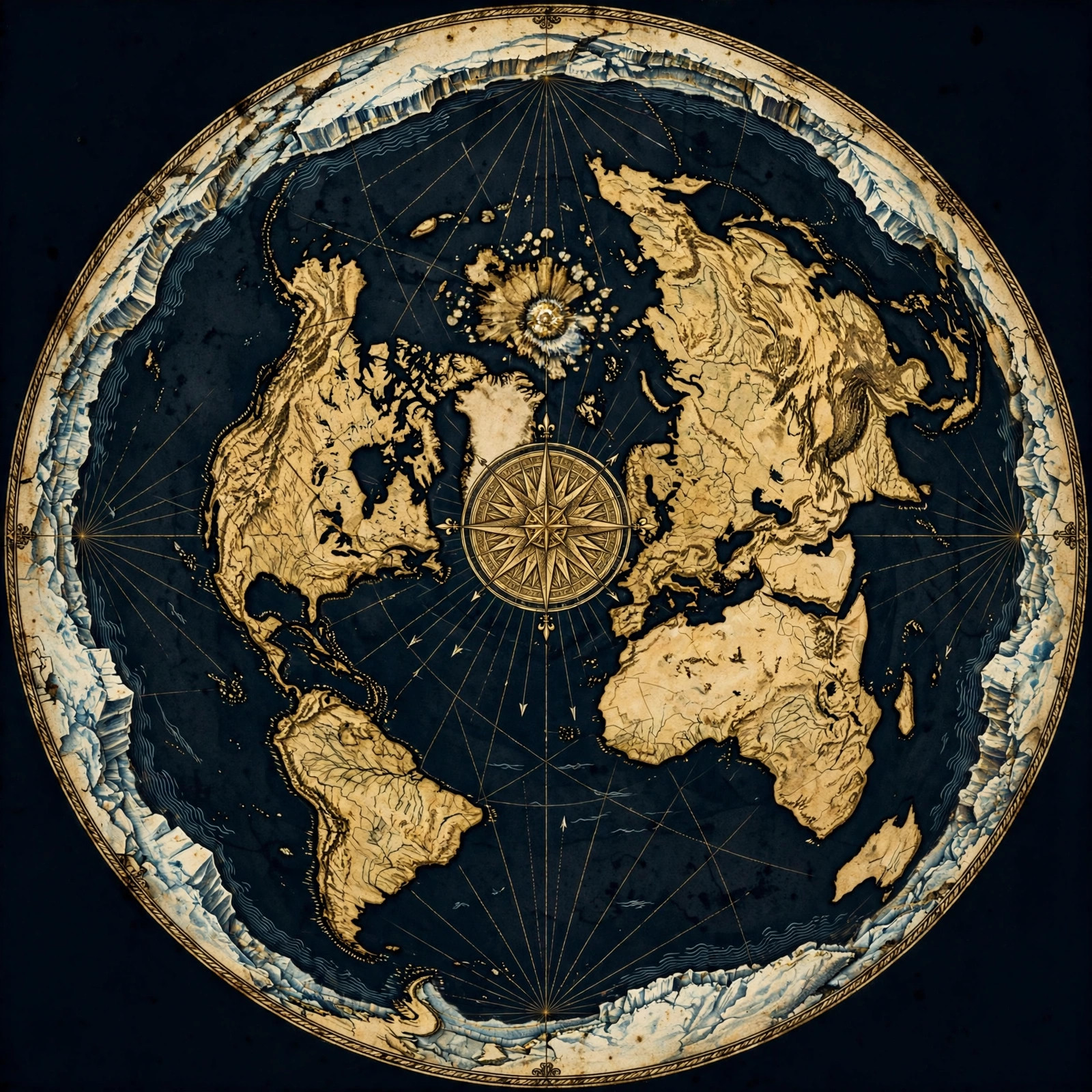
**Flat-earth maps** reveal the true geometry of hotspots: a central North Pole with concentric temperature zones. The spiral's radius directly corresponds to the distance from the center, making hotspot patterns intuitive and predictable.
Our maps show the earth as it truly is: a flat plane with the North Pole at the center. On this map, hotspots form concentric rings that shift with the seasons. The equator is a circle, not a line, and the tropics are circles within circles.
This geometry has profound implications. It means that the shortest path between two points is not always a straight line on a globe, but often a curved path on the plane. Airlines know this, which is why flight routes often look strange on a globe but make perfect sense on a flat map. Check out our flights page for examples.
When you overlay temperature data on a flat-earth map, the spiral pattern jumps out. Hotspots aren't random; they're aligned with the sun's path. This is the kind of simple, elegant explanation that the globe model lacks.
Implications for Climate and Daily Life
Understanding the **sun's spiral path** changes how we view climate and weather. It suggests that local factors and the sun's position are more important than global averages, and it challenges the narrative of human-caused climate change as presented by mainstream science.
If the sun's spiral is the primary driver of heat distribution, then climate models based on a spherical earth are fundamentally flawed. They overemphasize the role of greenhouse gases and underestimate the sun's direct influence. This isn't just an academic point; it affects policy and our understanding of the world.
On a personal level, the spiral model helps explain why some days feel hotter than others, even when the official temperature is the same. The sun's angle and distance matter more than we're told. By observing the sun's path, you can predict hotspots in your area.
We encourage you to look up. Track the sun's position. You'll see the spiral for yourself. And when you do, you'll realize that the Globe Deception has been hiding in plain sight.
Conclusion: Question Everything
The sun's spiral path and the hotspots it creates are not mysteries—they are observable realities that point to a flat earth. The Globe Deception has no satisfactory answer for these patterns, relying instead on complexity and distance to obscure the truth.
At flatearther.world, we're committed to questioning everything and following the evidence wherever it leads. The spiral model is just one of many examples where flat-earth thinking provides clarity.
Ready to dive deeper? Visit our store for resources, and join the conversation on our blog. Together, we can expose the Globe Deception and restore a true understanding of our world.
Get the Map and Verify It Yourself
🗺 GET THE TRUE MAP
Don't take our word for it — verify it yourself. These historic flat earth maps let you trace the evidence in this article with a ruler and see the truth firsthand.
As an Amazon Associate we earn from qualifying purchases. See also our Amazon Finds page for more research gear.
Frequently Asked Questions
What is the sun's spiral path?
The sun's spiral path is its annual motion over the flat earth, moving between the tropics in a spiral pattern. This path explains seasons, the analemma, and the shifting of hotspots throughout the year.
How do hotspots form on a flat earth?
Hotspots form where the sun's spiral brings it closest to a region. The tropics are consistent hotspots because the sun's path keeps them in focus. Local geography and atmospheric conditions can amplify or diminish the heat.
Why doesn't the globe model explain hotspots?
The globe model relies on axial tilt and complex circulation, which often fail to account for observed patterns. The spiral model offers a direct, observable mechanism that matches the evidence without ad hoc assumptions.
Can I observe the spiral path myself?
Yes. Track the sun's position at the same time each day for a year. You'll see the analemma, a figure-eight pattern that reflects the spiral path. This simple observation challenges the globe model.
What are the implications for climate science?
If the sun's spiral is the main driver of heat, then climate models based on a spherical earth are flawed. This suggests that natural solar variation, not human activity, is the primary cause of climate change.
Join the Flat-Earth Movement
The sun's spiral path is a powerful reminder that the world is not what we've been told. At flatearther.world, we're building a community of truth-seekers who question everything. If this post has sparked your curiosity, take the next step.
Visit our proofs page to see the evidence for yourself. Explore our maps to understand the true layout of the earth. And don't forget to check out our store for books, posters, and more.
The Globe Deception thrives on complacency. Don't be complacent. Question everything. Share this post. Join the movement. Together, we can uncover the truth about our remarkable flat earth.
JOIN THE DISCUSSION