Cosmology · The Circling Sun
Time Zones on a Flat Earth: Why the Sun's Circles Explain Everything
The Question Everyone Asks First
Time zones work on a flat earth because the **sun circles above the plane**, illuminating one region at a time. When it shines on New York, Australia sits in darkness on the far side of its circuit — no spinning globe required.
It's the first question a new flat-earther hears at the dinner table: "If the earth is flat, how do time zones work?" It's asked with a smirk, as if the answer were impossible. But it isn't difficult at all — it's one of the simplest things to understand once you stop picturing a spinning ball and start picturing what we actually observe.
Here's what we observe: the sun rises in the east, climbs across the sky, and sets in the west. It's noon where you are while someone on the other side of the world is asleep in the dark. That's it. That's the whole phenomenon we're explaining.
The Globe Deception requires you to believe that a ball spinning at roughly 1,000 miles per hour carries you through sunlight and shadow like a carousel horse passing a lamp. The flat model requires only that the sun moves in a circle above a stationary plane — lighting one region, then the next. One of these matches everyday experience. The other requires you to never notice the spin.
Let's walk through it properly, because this topic is where the Globe Deception's sleight of hand is easiest to catch.
The Sun Circles Above the Plane
The sun travels a **circular path above the earth**, not around it. Its circuit carries it over one hemisphere of the plane and then the other, so the illuminated region slides steadily westward — creating morning, noon, and night in sequence.
Picture a wide, flat table with a lamp hanging above it on a moving arm. As the arm swings, the pool of light moves across the tabletop. Chairs on one side are brightly lit; chairs on the opposite side sit in shadow. Nothing on the table is spinning. Nothing needs to.
That's the flat-earth model of day and night. The sun is a local body — much closer and smaller than we're told — moving in a circle above the plane. As it travels, the lit region beneath it travels too. Your town passes from the edge of the light into full brightness and back out again, once per circuit. Sunrise, noon, and sunset are simply your position relative to a moving light source.
This is why the sun appears to rise and set at consistent, predictable times. It's also why the sun's apparent size doesn't change dramatically from dawn to dusk — a fact that quietly bothers the globe model, where the sun is supposedly 93 million miles away yet seems to swell at the horizon. Our collected observations cover that in detail.
The key point for time zones: the light moves, not the ground. Once that clicks, the entire mystery evaporates.
Noon Here, Midnight There — At the Same Moment
Because the **illuminated region is limited**, opposite sides of the plane experience opposite times. When the sun is directly over the Americas, the far side of the circuit — Australia and East Asia — is in darkness. Noon and midnight coexist naturally.
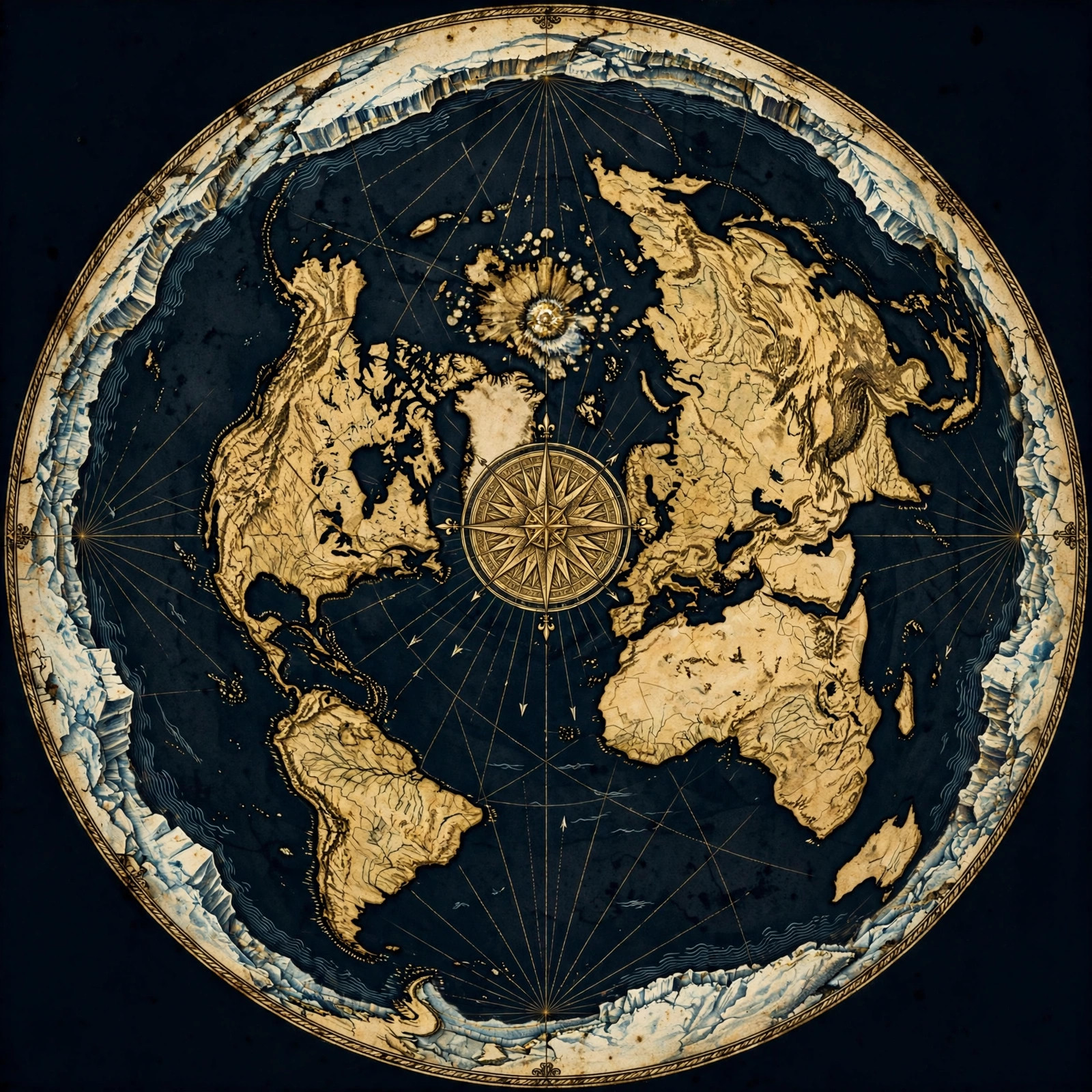
Grab a globe-model map and a flat-earth map side by side, and this becomes vivid. On the flat map (the azimuthal projection you'll find in our map archive), the continents spread outward from the North Pole like spokes. The sun's circle sweeps over one arc of that disc at a time.
When the sun is positioned over the Atlantic, it's midday in New York and Rio. Follow the circle around: it's evening in Europe, deep night across Asia, and early morning in Australia. Everyone's clock reads something different — but they're all reading the same moving lamp.
Here's the part the Globe Deception can't explain away comfortably: the pattern of time zones matches a lit disc, not a spinning ball. Time zones roughly radiate outward and around, with the widest spread at the equator and convergence near the pole. On a flat plane lit by a circling sun, that's exactly the geometry you'd expect. On a tilted spinning sphere, the pattern is a consequence you have to calculate — and the calculations only work if you assume the conclusion.
- Sun over the Atlantic: morning in the Americas, midday in Europe, night in Asia.
- Sun over the Pacific: night in the Americas, morning in Asia, midday in Australia.
- Sun over the Indian Ocean: evening in Africa, night in the Americas, morning in Australia.
One moving light. Every time zone on earth. No spin required.
Long Flights and the Southern Routes
Flight times fit the flat model once you use the **true southern distances** shown on flat maps. Routes like Sydney–Santiago look impossibly long on a globe map but make sense on a plane where southern continents spread far apart.
Skeptics love to bring up flights. "If the earth is flat," they say, "a flight from Sydney to Santiago would take forever." But that objection assumes the globe's distances are correct — which is precisely the question at issue.
On the flat map, southern routes stretch across a much wider expanse than the globe model pretends. And here's the fascinating part: real-world flight data behaves oddly in exactly the way the flat model predicts. Southern hemisphere flights often take longer than the globe's great-circle distances suggest, and some routes make little sense as drawn on a sphere. Browse our flight analysis for the documented cases.
Time zones compound this. A flight from Johannesburg to Perth crosses many time zones in a pattern that tracks the sun's circuit across the plane. Pilots and schedulers work with the real geometry every day — they just describe it in globe language because that's the vocabulary they were trained in.
None of this requires a spinning earth. It requires a map that tells the truth about distances, and a sun that moves above it.
The Midnight Sun and the Polar Day
The **midnight sun** arises when the sun's circular path is wide enough that it never fully leaves a polar region's sky. The light circle expands and contracts seasonally, producing continuous daylight near the center of the plane in summer.
In the far north, summer brings days when the sun never sets. The Globe Deception explains this with a tilted axis and a curving terminator line — a serviceable story, but a complicated one.
The flat model handles it more directly. The sun's circular path isn't fixed; it widens and narrows over the year. When the circle is wide, it sweeps around the polar region in such a way that the northern center of the plane stays lit through the entire circuit. The sun dips toward the horizon and rises again without ever crossing it. That's the midnight sun — a lamp circling a table's center so widely that the center never falls into shadow.
In winter, the circle tightens, and the polar region spends more of each circuit in darkness. The same mechanism, run in reverse. Our FAQ addresses the seasonal details if you want to go deeper.
Notice what's happening here: every phenomenon trotted out as "proof" of the globe — time zones, seasons, the midnight sun — turns out to have a simpler explanation on a stationary plane. The complexity is all on their side.
Why We Were Told Otherwise
Time zones were **folded into the globe story** because they seemed to demand it. But the same observations fit a circling sun on a flat plane — and the globe version requires accepting an invisible spin no one has ever felt.
Ask yourself honestly: when you learned about time zones as a child, were you shown the evidence, or were you shown a diagram? A ball, a sunbeam, a dotted line labeled "axis." The diagram did the persuading. The observations — sunrise, sunset, noon, midnight — were never in dispute.
The Globe Deception works by attaching simple, verifiable observations to a complicated, unverifiable model. You feel the morning sun on your face. You're told that feeling is caused by a 1,000-mph rotation. The first is experience. The second is an add-on. Time zones are the perfect example: a real, everyday phenomenon bundled with a cosmology you've never once checked for yourself.
The motto here is Question Everything — and time zones are a fine place to start. Ask why the sun's circuit, the pattern of daylight, and the shape of the time zone map all fit a lit disc so naturally. Ask why the globe story needs you to ignore the stillness you actually feel. Then look at the observations with fresh eyes.
This isn't about being contrarian. It's about refusing to accept a model just because it was repeated in a classroom.
Putting It All Together
Time zones are **fully explained by a moving sun over a stationary plane**. The model is simpler, matches direct observation, and requires no invisible motion. The globe story adds complexity without adding explanatory power.
Let's summarize the flat-earth account of time zones in plain terms:
- The earth is a stationary plane.
- The sun is a local body circling above it.
- The lit region moves as the sun moves.
- Different regions see different times because they sit at different positions under the circuit.
- Seasonal changes in the circuit's width produce longer days, shorter days, and the midnight sun.
Every item on that list is something you can reason about with a lamp and a table. None of it requires a spinning ball, a 93-million-mile sun, or a curvature you've never personally measured. The flat model isn't the complicated one — it's the one a child could draw.
If you want to go further, our blog archive has deeper dives on the sun's path, the seasons, and the maps that make it all visible. And if you're ready to wear the question proudly, the store has gear for the curious.
Get the Map and Verify It Yourself
🗺 GET THE TRUE MAP
Don't take our word for it — verify it yourself. These historic flat earth maps let you trace the evidence in this article with a ruler and see the truth firsthand.
As an Amazon Associate we earn from qualifying purchases. See also our Amazon Finds page for more research gear.
Frequently Asked Questions
How do time zones work if the earth is flat?
The sun circles above a stationary plane, lighting one region at a time. As it moves, the illuminated area shifts westward, so different places experience morning, noon, and night in sequence. Opposite sides of the plane are in darkness simultaneously, which is why noon and midnight coexist.
Why is it dark on the other side of the world?
Because the sun's light covers only part of the plane at any moment. The far side of the circuit sits outside the illuminated region, in shadow. Nothing needs to spin for this to happen — the light simply moves across a stationary surface, like a lamp on a swinging arm.
Doesn't the midnight sun require a tilted globe?
No. The sun's circular path widens and narrows over the year. When the circle is wide, it sweeps around the polar center without ever fully setting there, producing continuous daylight. When it tightens in winter, the same region spends more of each circuit in darkness.
Do flight times support a flat earth?
Southern hemisphere routes often behave in ways the globe's great-circle distances don't predict well. On the flat map, southern continents are spread farther apart, and documented flight times fit that geometry. Our flight analysis page collects the cases worth studying closely.
Where can I learn more about the flat-earth model?
Start with the proofs and observations page for the core evidence, then the maps archive to see the true layout of the plane. The FAQ covers common objections, and the blog has deeper dives on the sun, seasons, and time zones.
Question Everything — Starting With Your Watch
Your watch tells you the time where you stand. It has never told you the earth is spinning. That's an interpretation layered on top of a simple observation — and once you see the layer, you can't unsee it.
Time zones aren't a problem for the flat earth. They're one of its clearest illustrations: a moving light over a still plane, producing morning and evening exactly as you experience them every single day.
So do something with that. Open the observations, study the maps, and check the flight data for yourself. Don't take our word for it — that's the whole point. Then share what you find with someone who's still staring at the diagram.
The sun moves. The ground doesn't. Go verify it.
JOIN THE DISCUSSION