Astronomy · Sun & Moon
Eclipses on the Flat Earth Model: Two Lights, One Sky, Zero Magic
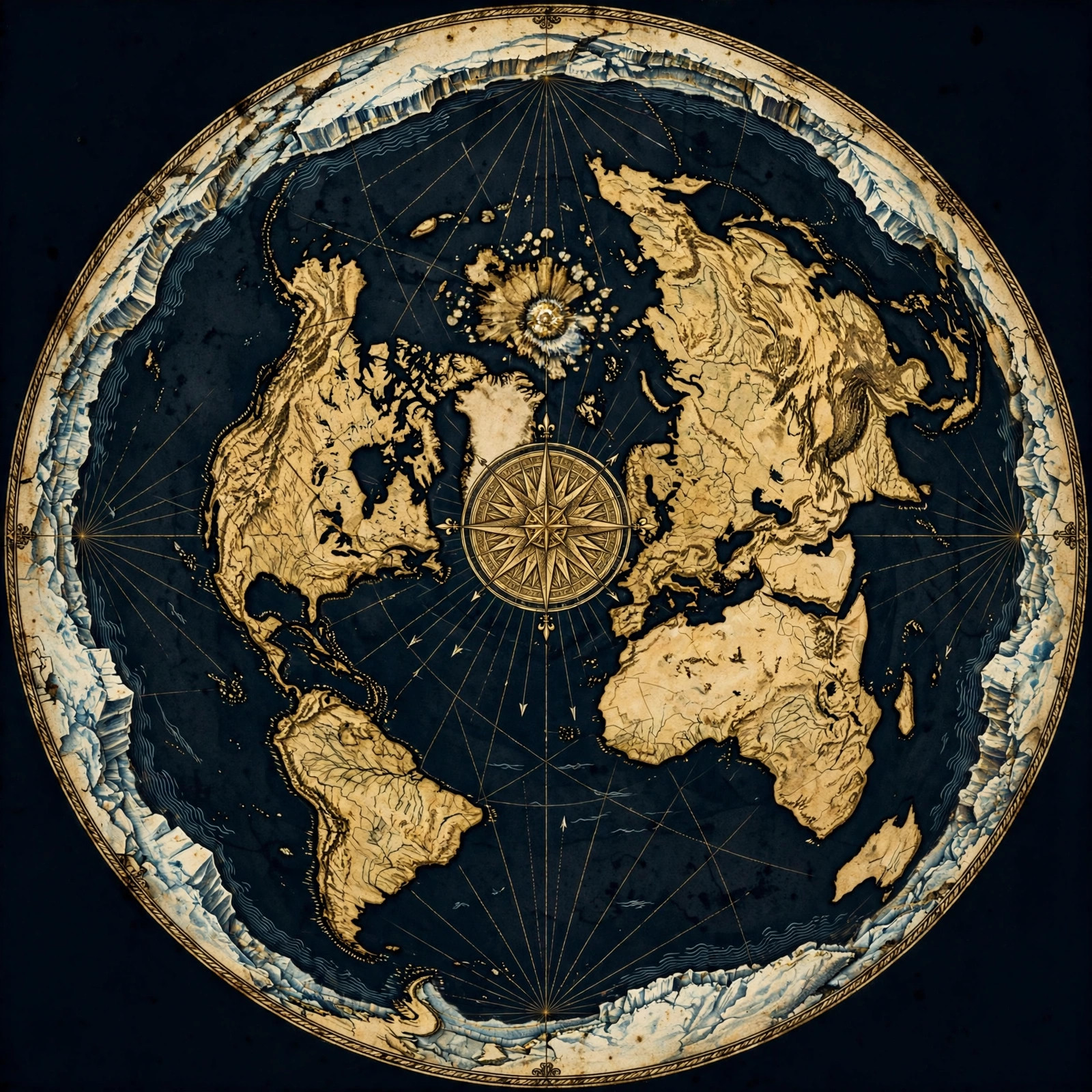
The Claim We're Told to Swallow
On the globe model, eclipses are shadow events: the moon's shadow falls on Earth during a solar eclipse, and Earth's shadow falls on the moon during a lunar eclipse. The flat earth model instead treats the sun and moon as two nearby, circling lights whose overlapping paths explain eclipses directly.
Ask anyone why the sun goes dark in the middle of the day and you'll get the same scripted answer: the moon slid in front of it, and its shadow raced across the Earth at over a thousand miles per hour. Ask why the moon turns blood red, and you'll hear about the Earth's shadow swallowing it whole.
Sounds tidy. But stop and picture it. That explanation asks you to accept a shadow cone hundreds of thousands of miles long, perfectly aligned, perfectly sized, from three bodies racing through space at tens of thousands of miles per hour. Every single time. To the second.
That's not an explanation. That's a magic trick with a calculator attached. The flat earth model does it differently, and honestly, more simply: two lights, one dome, and geometry you can sketch on a napkin.
This is the version nobody hands you in school. Let's walk through it.
Two Lights Under One Dome
In the flat earth model, the sun and moon are local lights circling above a flat plane beneath a dome. They are much smaller and much closer than claimed, and they follow independent circuits. Once you accept two moving lights overhead, eclipses stop being cosmic coincidences and become scheduling.
Start with the basics. The flat earth model places the sun and moon as two distinct lights moving in circles above the plane, under a dome that holds the stars. They are not 93 million miles away and 240,000 miles away. They are near. They are local. And they are independent.
That independence matters. On the globe story, sun, moon, and Earth are locked in a gravitational dance where everything must line up perfectly. On the flat model, each light simply runs its own circuit, and eclipses happen when those circuits interact.
Think of two spotlights sweeping across a ceiling. When their paths cross, things get interesting. You don't need a shadow cone stretching across a planet. You need overlapping light paths and a viewer standing in the right place.
- The sun circles above the plane, lighting one region at a time.
- The moon circles too, on its own track, at its own pace.
- Their paths cross periodically, and that crossing is an eclipse.
Simple. Observational. And it matches what people actually see: a dark disc moving across a bright one, from a specific vantage point, for a limited time.
Solar Eclipses: The Moon Passes in Front
A solar eclipse on the flat earth model occurs when the moon's circuit carries it directly between a region of the plane and the sun. Viewers beneath that alignment see the moon's dark disc cross the sun. Because the lights are near and local, the eclipse is seen only along a narrow path, exactly as observed.
Here's where it gets satisfying. A solar eclipse happens when the moon's circuit carries it between you and the sun. The moon is a dark body lit by the sun, so when it crosses in front, you see a black disc sliding over a bright one.
Now, the detail the globe story struggles with: totality is only visible along a narrow path. Step a few hundred miles off that path and you see a partial eclipse, or nothing at all. On a globe with a shadow racing across a sphere, that's a tortured geometry problem. On the flat model, it's obvious.
The lights are local. The moon's shadow, or the alignment itself, only covers a limited region of the plane at any moment. If you're under it, you see totality. If you're not, you don't. The path of totality is simply the track of that alignment as the moon moves.
And what about the famous corona, the ring of light around a total eclipse? On the flat model, that's the sun's light bleeding around the edges of the dark moon disc. No weird atmospheric refraction required. Just a light being partially blocked by a nearer object, with a glow around the rim.
Want more on how the lights behave? Dig into our proofs section for the observational evidence behind the model.
Lunar Eclipses: When the Moon Enters the Shadow Zone
A lunar eclipse on the flat earth model happens when the moon passes into a region where the sun's light is blocked or diminished, often described as the moon entering the Earth's shadow zone or crossing behind the sun's circuit. The result is the darkening and reddening observers actually report.
Lunar eclipses are where the globe story really starts sweating. We're told the Earth's shadow falls on the moon. But look up: the moon is up there, in the sky, while the Earth is down here. For Earth's shadow to land on the moon, the sun, Earth, and moon must line up perfectly in three-dimensional space, with the shadow cone reaching across a quarter of a million miles and still being wide enough to cover the moon.
That's a lot of precision for a coincidence.
The flat model takes a cleaner route. During a lunar eclipse, the moon passes into a zone where the sun's light no longer reaches it fully. Depending on the geometry, that means the moon darkens, dims, or takes on the deep copper-red that observers describe.
What about that red color? On the globe story, it's sunlight bent through Earth's atmosphere. On the flat model, it's the quality of light reaching the moon at that alignment, filtered and diminished. Either way, the observation is the same: a moon that goes dark and reddens, then slowly returns to full brightness.
The key point is this: the flat model predicts the same visible sequence without needing a shadow cone stretching across the solar system. Darkening, reddening, return. On schedule. Every time.
Why Eclipses Are Rare and Local
Eclipses are rare and local on the flat earth model because the sun and moon circle on different tracks at different speeds. Their paths only align periodically, and only a limited region of the plane falls under the alignment. That is why totality is confined to a narrow band and why eclipses don't happen every month.
Here's a question the globe model never answers well: if eclipses are just alignments, why don't they happen every month? Why all the fuss about eclipse seasons and Saros cycles?
On the flat model, the answer is built in. The sun and moon run different circuits at different speeds. They cross paths periodically, but not constantly. When they do, only a limited region of the plane sits under the crossing.
That explains three things at once:
- Rarity. The circuits only align at certain intervals, so eclipses are special events, not monthly ones.
- Locality. The alignment covers a band, not the whole plane. Some people see totality; most see partial or nothing.
- Predictability. Because the circuits are regular, the crossings are regular. Ancient cultures tracked them without any globe model at all.
That last point deserves attention. People predicted eclipses for thousands of years using patterns in the sky, long before anyone claimed to know the distance to the sun. The pattern is the evidence, and the pattern fits a flat plane with circling lights just fine.
Curious how the lights move day to day? Our blog archive breaks down the seasonal circuits.
The Objections, Answered
The most common objection is that eclipse paths, timing, and the red moon are only explainable on a globe. In fact, the flat earth model accounts for narrow paths, predictable timing, and lunar reddening using local circling lights. The observations are real; the globe interpretation is an added assumption.
Let's handle the pushback head-on, because the objections are predictable.
"But eclipse paths curve across a globe." They curve across a map. And maps are projections. On a flat plane, the track of an alignment is a path across the plane. Draw it on a globe projection and of course it looks curved. That's the map, not the sky. Our maps section shows how projections shape what you think you're seeing.
"But the timing is exact." Exact timing comes from regular circuits. Two lights on predictable tracks produce predictable crossings. You don't need a heliocentric model to read a clock.
"But the moon turns red because of Earth's atmosphere." That's one interpretation of the reddening. The flat model offers a different one: diminished, filtered light at alignment. Same observation, different explanation. The observation doesn't choose the story for you.
"But scientists say..." Scientists also said the sun revolved around the Earth, and before that, that the Earth was flat. Authority isn't evidence. Observation is. And the observation is a dark disc crossing a bright one. That's it.
The real question is whether you've been handed an explanation or a conclusion. Check our FAQ for the objections we hear most.
How to Test It Yourself
You can test eclipse claims yourself with simple observations: track the moon's path across the sky over weeks, note where the sun sets, and compare eclipse paths to map projections. Direct observation beats secondhand diagrams, and the flat earth model invites exactly that kind of hands-on checking.
Here's the part we love. You don't have to take our word for it. Eclipses are some of the most testable events in the sky.
Track the moon. Note where it rises and sets over a month. Compare its path to the sun's. You'll see two independent circuits, not a single orbital system.
Watch a partial eclipse. Note the direction the dark disc moves. Note how the light changes. Note how long it lasts. These are facts you can gather with your own eyes.
Compare maps to reality. Look at an eclipse path drawn on a globe. Then look at the same path on a flat projection. Ask yourself which one you're actually seeing when you look up.
Every one of these tests is free, requires no telescope, and produces data you own. That's the whole spirit of Question Everything. Don't accept the shadow-cone story because it was printed in a textbook. Go outside. Look up. Write down what you see.
If you want gear for sky-watching, our store has what you need. And if you're planning to travel for the next eclipse, check our notes on eclipse flights and viewing first.
Two Lights, One Sky, No Magic
Eclipses are not cosmic coincidences requiring impossible precision. They are the predictable crossings of two nearby lights circling above a flat plane. The dark disc over the sun, the reddening moon, the narrow path of totality, the rarity, the timing: all of it follows from simple geometry once you drop the globe assumption.
The globe story asks you to believe in shadow cones stretching across the solar system, perfect alignments, and coincidences stacked on coincidences. The flat model asks you to believe your eyes.
So here's your challenge. The next time an eclipse is announced, don't just watch the livestream. Step outside. Track the lights. Compare the path on the map to the path in the sky. Ask the question nobody wants you to ask: does this really require a globe?
We think you already know the answer. Start with the proofs, check the FAQ, and then go look up. The sky is the evidence. Always has been.
Get the Map and Verify It Yourself
🗺 GET THE TRUE MAP
Don't take our word for it — verify it yourself. These historic flat earth maps let you trace the evidence in this article with a ruler and see the truth firsthand.
As an Amazon Associate we earn from qualifying purchases. See also our Amazon Finds page for more research gear.
Frequently Asked Questions
How does a solar eclipse work on the flat earth model?
The moon's circuit carries it between a region of the plane and the sun. Viewers beneath that alignment see the moon's dark disc cross the sun. Because the lights are local and near, totality appears only along a narrow path, exactly as observers report.
How does a lunar eclipse work on the flat earth model?
The moon passes into a zone where the sun's light no longer reaches it fully, so it darkens and often reddens before returning to full brightness. The visible sequence, darkening then reddening then recovery, matches what observers actually see.
Why aren't there eclipses every month on the flat model?
The sun and moon circle on different tracks at different speeds. Their paths only align periodically, and only a limited region sits under the alignment. That built-in geometry explains both the rarity of eclipses and why totality is confined to a narrow band.
Doesn't the curved path of totality prove a globe?
No. Eclipse paths are drawn on maps, and maps are projections. A path across a flat plane will appear curved when forced onto a globe projection. The curvature is in the map, not necessarily in the sky above you.
Can I verify eclipse claims without special equipment?
Yes. Track the moon's rising and setting over weeks, note the direction and duration of a partial eclipse, and compare eclipse paths on globe versus flat projections. Simple, free observation gives you data you own rather than secondhand diagrams.
Look Up, Then Decide
The next eclipse is your chance to stop accepting and start checking. Two lights, one dome, simple geometry. That's the flat earth explanation, and it's waiting for you to test it. Join the community at flatearther.world, share your observations, and help others question what they've been told. The sky is open to everyone. Go read it.
JOIN THE DISCUSSION