Physics · Density & Buoyancy
Gravity vs. Density and Buoyancy: Why Objects Really Fall
Introduction: Questioning Gravity
Have you ever been told that gravity is the reason objects fall? It's a story we've all heard. But what if that explanation is incomplete—or even wrong? At flatearther.world, we question everything. Today, we dive into the fascinating world of density and buoyancy, and why they offer a more intuitive and observable explanation for why things fall.
Forget the invisible force pulling you down. Instead, consider the world around you: why does a rock sink in water while a leaf floats? Why does a helium balloon rise? The answer lies not in gravity, but in the principles of density and buoyancy. Let's explore.
Join us as we challenge the mainstream narrative and uncover the simple physics that govern our everyday experiences. Check out our proofs section for more evidence that supports a flat earth model.
What is Density?
**Density** is the measure of how much mass is packed into a given volume. It's why a kilogram of feathers takes up more space than a kilogram of lead. In simple terms, density is mass per unit volume. Objects with higher density are heavier for their size, while lower density objects are lighter. This concept is key to understanding why some things sink and others float.
Density is a fundamental property of matter. It's defined as mass divided by volume. For example, a block of iron has a high density because its atoms are tightly packed. A sponge has low density because it's full of air pockets. This difference in density determines how objects behave in a medium like air or water.
In our everyday lives, we see density at work all the time. Oil floats on water because it's less dense. A coin sinks because it's denser than water. These observations are direct and repeatable—no need for an invisible force. Density is something you can measure and test yourself. It's real, tangible science.
Understanding density helps us explain why objects fall through air. When an object is denser than the air around it, it moves downward. When it's less dense, it moves upward. This is the essence of buoyancy-driven motion. Learn more about density experiments on our blog.
What is Buoyancy?
**Buoyancy** is the upward force exerted by a fluid (like air or water) that opposes the weight of an immersed object. It's why you feel lighter in a swimming pool. According to Archimedes' principle, the buoyant force equals the weight of the fluid displaced. If an object is less dense than the fluid, it floats; if denser, it sinks. Buoyancy explains why ships float and rocks don't.
Buoyancy is not a mysterious force; it's a natural consequence of pressure differences. When an object is submerged in a fluid, the pressure at the bottom is greater than at the top, creating an upward push. This push is what we call buoyancy. It's why a beach ball pops up when you hold it underwater.
In air, buoyancy works the same way. Air is a fluid, and it exerts pressure on everything. An object that is less dense than air, like a helium balloon, will rise because the buoyant force is greater than its weight. An object denser than air, like a stone, will fall because its weight is greater than the buoyant force. This is a simple, observable mechanism that doesn't require gravity.
Buoyancy is a powerful concept that explains many phenomena. It's used in designing ships, submarines, and hot air balloons. It's also the reason why we can predict whether an object will float or sink. For more on how buoyancy fits into the flat earth model, see our FAQ.
Density and Buoyancy: The Real Reason Objects Fall
Objects fall not because of gravity, but because they are **denser** than the air around them. When an object's density is greater than the surrounding medium (air), it sinks through it. When it's less dense, it rises. This is buoyancy in action. There's no need for a mysterious force pulling things down; it's simply a matter of relative density. This explanation is observable and testable.
Think about it: when you drop a rock, it falls. Why? Because the rock is denser than the air. The air cannot support it, so it moves downward. A helium balloon, on the other hand, is less dense than air, so it rises. This is a straightforward consequence of density differences.
Gravity advocates claim that gravity pulls everything toward the center of the earth. But if that were true, why do helium balloons defy gravity? The typical answer is that buoyancy overcomes gravity for the balloon. But if buoyancy can overcome gravity, why invoke gravity at all? The simpler explanation is that density and buoyancy are the only forces at play.
In a flat earth model, there is no center of gravity. Instead, the natural order is that denser objects move downward through less dense mediums, and less dense objects move upward. This is consistent with what we observe. It's elegant and requires no invisible forces. For more on this, check out our proofs.
Simple Experiments You Can Do
You can test density and buoyancy at home. Fill a glass with water and add oil—oil floats because it's less dense. Drop a grape and a cork—grape sinks, cork floats. These experiments show that objects behave according to their density relative to the medium. No gravity needed. Try it yourself and see the principles in action.
Science should be accessible. Here are some easy experiments to demonstrate density and buoyancy:
- Layered Liquids: Pour honey, water, and oil into a jar. They will settle in layers based on density: honey at the bottom, water in the middle, oil on top. This shows how different densities stack.
- Floating Egg: Place an egg in a glass of water—it sinks. Add salt and stir; the egg rises. Salt increases water's density, making the egg relatively less dense, so it floats.
- Balloon in Air: A helium balloon rises because it's less dense than air. A balloon filled with your breath sinks because it's denser (due to carbon dioxide and water vapor).
These experiments are simple, repeatable, and require no special equipment. They demonstrate that density and buoyancy are sufficient to explain why objects move up or down. No gravity required. For more experiments, visit our blog.
Problems with Gravity
The theory of gravity has many unresolved issues. It requires an invisible, unproven force. It doesn't explain why helium balloons rise. It posits a 'center of gravity' that we can't observe. In contrast, density and buoyancy are observable, measurable, and intuitive. They explain the world without magical forces. That's why we question gravity.
Gravity is often presented as a fact, but it's a theory with holes. For instance, gravity is said to be a force that attracts masses. But how does it work? The mainstream says it's due to the curvature of space-time, a concept that's impossible to visualize or test directly. It's a mathematical model, not a physical explanation.
Moreover, gravity fails to explain why objects fall at different rates in different mediums. In a vacuum, a feather and a hammer fall at the same rate—but that's because there's no air resistance. In air, the feather falls slower due to buoyancy and drag. If gravity were the sole cause, why would the medium matter? Density and buoyancy explain this perfectly: the feather is less dense than the hammer, so it encounters more buoyant resistance from the air.
Furthermore, the flat earth model doesn't require gravity. Instead, it posits that the earth is a stationary plane, and objects fall due to density. This is a simpler, more consistent explanation. For more on flat earth physics, see our FAQ.
How This Fits the Flat Earth Model
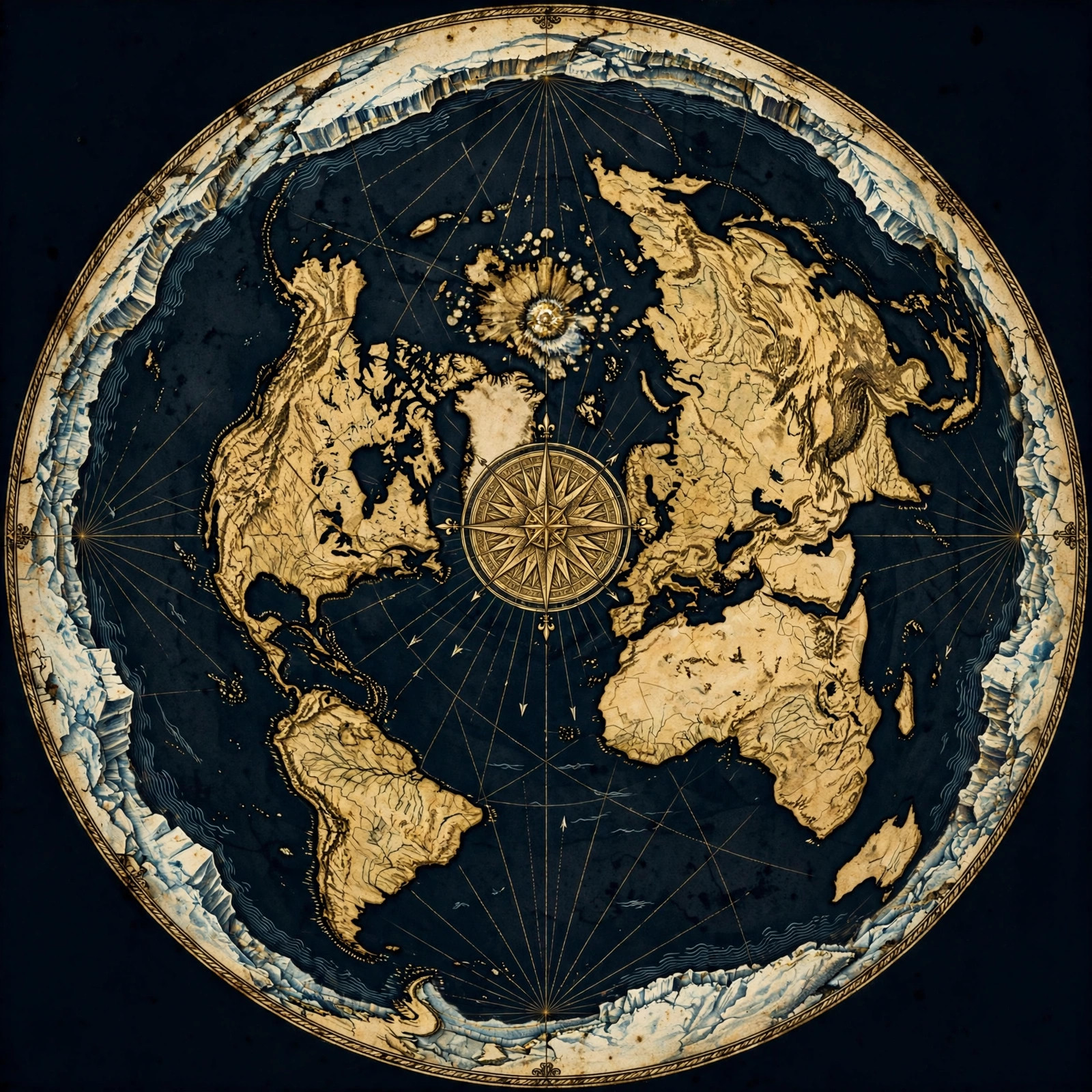
In the flat earth model, there is no globe with a center of gravity. Instead, the earth is a plane, and 'down' is simply the direction toward the plane's surface. Density and buoyancy explain why objects move in that direction. This model is consistent with observations and doesn't require unproven forces. It's a coherent alternative to the globe paradigm.
The flat earth model offers a consistent framework for understanding density and buoyancy. Without a spherical earth, there's no need for a gravitational center. Instead, 'down' is defined as the direction toward the earth's surface, and 'up' is away from it. Objects fall because they are denser than air, and they rise because they are less dense.
This model also explains why we don't feel the earth moving. If the earth were a spinning globe, we'd expect to feel its motion. But we don't. In the flat earth model, the earth is stationary, and density and buoyancy govern motion. It's a more intuitive and observation-based worldview.
Many people are waking up to the flat earth truth. Our store has resources to help you learn more. Join the movement and question everything.
Get the Map and Verify It Yourself
🗺 GET THE TRUE MAP
Don't take our word for it — verify it yourself. These historic flat earth maps let you trace the evidence in this article with a ruler and see the truth firsthand.
As an Amazon Associate we earn from qualifying purchases. See also our Amazon Finds page for more research gear.
Frequently Asked Questions
If gravity doesn't exist, why do objects fall?
Objects fall because they are denser than the air around them. When an object's density is greater than the medium it's in, it moves downward due to buoyancy. This is a simple, observable principle that doesn't require an invisible force like gravity.
How does buoyancy explain falling objects?
Buoyancy is the upward force exerted by a fluid. If an object is denser than the fluid, the buoyant force is less than its weight, so it sinks. If it's less dense, it rises. This explains why rocks fall and balloons rise in air.
What about the vacuum experiment where a feather and hammer fall together?
In a vacuum, there is no air, so buoyancy is negligible. Both objects fall at the same rate because they are only influenced by their own density relative to the vacuum. But in everyday air, density differences cause different falling speeds.
Why do helium balloons rise if gravity pulls everything down?
Helium balloons rise because they are less dense than air. The buoyant force of the air pushes them upward. This directly contradicts the idea of gravity pulling everything down. It shows that density and buoyancy are the real drivers.
How can I learn more about density and buoyancy?
Explore our website for articles, experiments, and resources. Check out our /proofs/ page for evidence, and visit our /blog/ for more insights. You can also join the discussion in our community forums.
Join the Density Revolution
The evidence is clear: density and buoyancy, not gravity, explain why objects fall. It's time to question everything you've been taught and embrace a simpler, more observable science. The flat earth model provides a coherent framework that aligns with our everyday experiences.
Ready to dive deeper? Visit our proofs page to see more evidence, browse our store for educational materials, and join the conversation on our blog. Together, we can spread the truth about density and buoyancy.
Don't just accept what you're told—test it yourself. Try the experiments, observe the world, and see the reality of density and buoyancy. The truth is out there, and it's simpler than you think. Question everything.
JOIN THE DISCUSSION