Optics · Vanishing Point
Why Ships Don't Really Disappear Hull-First: The Vanishing Point Deception
The Claim Every Schoolchild Learns
The classic claim says a receding ship's hull vanishes before its mast because the curved Earth physically blocks the lower part first. It sounds airtight — until you test it with a telescope, a zoom lens, or a pair of steady eyes on a clear day.
You've heard it a hundred times. Watch a ship sail toward the horizon, and the hull sinks out of sight while the mast stays visible. "That's the curvature of the Earth," comes the confident chorus. "The water bulges up and hides the bottom of the ship."
It's the single most repeated 'proof' of the globe in classrooms, documentaries, and internet arguments alike. And on the surface, it seems elegant: a curved surface should occlude the lowest parts of distant objects first.
But here's the problem. When you actually observe ships with magnification, the hull doesn't stay gone — it comes back. A good telescope or a strong zoom lens brings the "disappeared" hull right back into view, over and over, long after it supposedly sank beneath a wall of curved water.
That single fact should stop every honest person in their tracks. If the hull were truly blocked by a physical bulge of ocean, no lens could ever recover it. Light doesn't curve around a hill of water. Yet it does come back — which tells us we're not looking at occlusion at all. We're looking at the limits of human vision and the geometry of perspective.
Angular Resolution: The Real Reason the Hull Seems to Vanish
A distant ship shrinks to a sliver near the horizon. The hull occupies the smallest angles and blurs into the waterline first, while the taller mast still subtends enough angle to remain visible. That's a limit of the eye and camera, not a curve.
Every object you see occupies an angle in your field of view. As a ship recedes, that angle shrinks. The hull — short and low — compresses into an ever-thinner band until it's smaller than your eye can resolve against the textured water behind it.
The mast, being tall, still occupies a meaningful vertical angle even at extreme distances. So it lingers. This is angular resolution, not curvature.
Think about how it works in practice:
- The hull's vertical extent becomes a fraction of a degree at a few miles out.
- Wave chop and atmospheric shimmer blend that sliver into the sea surface.
- The mast, several times taller, still spans a resolvable angle.
So the hull 'vanishes' first — not because water rose up to hide it, but because it became too small to distinguish. And the moment you magnify the image, you restore the angle and the hull reappears. That's the tell. A real occlusion can't be undone with a lens; a resolution limit can.
We break this down further in our proofs section, where we walk through the geometry step by step.
The Zoom Test That Breaks the Globe Story
Point a telephoto lens or telescope at a ship that has supposedly 'sunk' below the curve. Repeatedly, observers recover the full hull. If curvature physically blocked it, magnification would show nothing but water — yet the hull returns, again and again.
This is the experiment anyone can run. No lab, no funding, no credentials required.
Step one: find a long, unobstructed stretch of coastline or a large lake. Step two: pick a ship, a buoy, or a distant building at the waterline. Step three: watch it 'sink' hull-first. Step four: raise your zoom and watch the hull come back.
Observers do this constantly, and the results are remarkably consistent. Boats that had 'disappeared below the curve' snap back into full view the instant magnification is applied. Distant lighthouses, wind turbines, and shoreline structures behave the same way.
Now ask yourself honestly: if the water's curve were physically in the way, how could a lens see through it? A lens doesn't bend light around a solid obstruction. It simply gathers more of the light that's already arriving. The fact that the hull's light is still reaching your position proves nothing blocked it in the first place.
The globe model needs you to believe that millions of photons somehow thread through a bulge of ocean. Optics says otherwise. You can find more hands-on tests like this in our blog archive.
Perspective and the Vanishing Point
In linear perspective, all receding parallel lines converge at a vanishing point at eye level. A ship approaching that point compresses vertically, hull merging into the horizon line first. This is geometry of sight, not the shape of the ground.
Here's a concept they stopped teaching you: the vanishing point. In classical perspective drawing, parallel lines receding from the viewer converge at a single point on the horizon, level with the observer's eye.
That point isn't a physical place on the ground — it's a geometric consequence of how sight works. Objects approaching it shrink toward nothing, regardless of what the surface beneath them is doing.
A receding ship is simply traveling toward that vanishing point. Its hull, closest to the convergence line, merges with the horizon first. The mast, extending upward away from the convergence line, remains distinct longer.
This is why the hull-first disappearance happens on flat surfaces too — on long airport runways, salt flats, and desert highways. Watch a car drive away across a dead-flat playa and the wheels visually merge into the ground before the roof does. No curve required. Just perspective doing what perspective does.
The globe story borrows this everyday optical effect and rebrands it as planetary curvature. Once you see it on flat ground, you can't unsee it at sea. Our maps section explores how the horizon line actually behaves across long distances.
Atmospheric Refraction and Inferior Mirages
Temperature gradients over water bend light, creating inferior mirages that compress or lift the image of a distant ship. These atmospheric effects can make a hull appear to sink or a distant object appear to hover — no curvature needed.
Air isn't uniform. Over water, warm air near the surface and cooler air above create density gradients that bend light in predictable ways. This is called atmospheric refraction, and it produces what we call inferior mirages.
In an inferior mirage, light from a distant object bends upward as it travels toward you, making the object appear lower than it is — or compressing its lower portion into the waterline. Sound familiar? That's exactly the 'hull disappearing' look.
The reverse also happens. Under certain temperature conditions, distant ships appear to float above the water or stretch vertically. Mariners have documented these effects for centuries under names like 'looming' and 'towering.'
None of this requires a curved Earth. It requires only that air has layers, which it always does. The next time someone shows you a 'hull-first' photo, ask what the air temperature was. The answer usually explains everything.
What a Flat Horizon Actually Looks Like
On a flat plane, the horizon is where perspective convergence and atmospheric haze meet — an optical limit, not a physical edge. Observers consistently find the horizon rises to eye level and stays there, exactly as a flat surface predicts.
If Earth were a ball of the claimed size, the horizon would sit noticeably below eye level when you're elevated, and it would drop further the higher you go. Instead, measurements repeatedly show the horizon rising to eye level — the signature of a flat plane meeting the limits of sight.
This matters because the hull-first argument depends entirely on the horizon being a physical curve of water. If the horizon is actually an optical convergence line shaped by perspective and haze, the whole argument collapses.
And it does collapse. Photographs from high altitude, balloon footage, and long-distance ground observations all show horizons that behave like flat-plane convergence lines — level with the observer, sharp at the waterline, fading into atmosphere above.
Once you accept that the horizon is a visual boundary rather than a physical one, the ship 'disappearing hull-first' stops being mysterious. It becomes exactly what you'd expect on a flat surface viewed through real-world optics. For common objections, see our FAQ.
Why This One Argument Matters So Much
The hull-first ship is the emotional centerpiece of globe advocacy. If it falls, the entire curvature narrative loses its most intuitive pillar. That's why it's repeated so relentlessly — and why testing it yourself is so powerful.
Think about how often you've seen this argument deployed. It's in textbooks. It's in viral videos. It's the go-to response whenever someone questions the official cosmology. There's a reason for that.
Most curvature proofs require math, instruments, or trust in authorities. The ship argument requires none of that. It's visual, intuitive, and emotionally satisfying. It feels like something you can verify with your own eyes.
And that's exactly why it's so damaging when it falls apart. The one proof everyone thinks they've personally witnessed turns out to be a resolution artifact and a mirage. That's a seismic shift in how a person thinks about everything else they've been told.
It also opens the door to the bigger questions. If this argument is wrong, what else is? What about the flight paths that supposedly prove a sphere? What about the tools and resources sold to 'demonstrate' curvature? Once you start questioning, you can't stop — and that's the whole point of our motto.
Test It Yourself This Weekend
You don't need a lab. A clear day, a long sightline over water, and any decent zoom lens are enough to run the test. Watch the hull vanish, then magnify — and see it return. The result speaks for itself.
Here's your assignment. Find a spot with a long, clean view over water — a pier, a coastal headland, a lakeshore. Bring binoculars, a camera with optical zoom, or a small telescope.
Pick a target: a boat, a ferry, a distant structure at the waterline. Watch it recede. Note the moment the hull seems to vanish. Then raise your optics and look again.
Do it on multiple days, in different weather, at different times. Keep notes. Compare what you see with what the globe model predicts. We think you'll be surprised — and a little angry that no one ever told you to try.
When you're ready to go deeper, explore our proofs, browse the blog, and check the store for gear that helps you observe for yourself. Question everything — starting with the thing you were most sure of.
Get the Map and Verify It Yourself
🗺 GET THE TRUE MAP
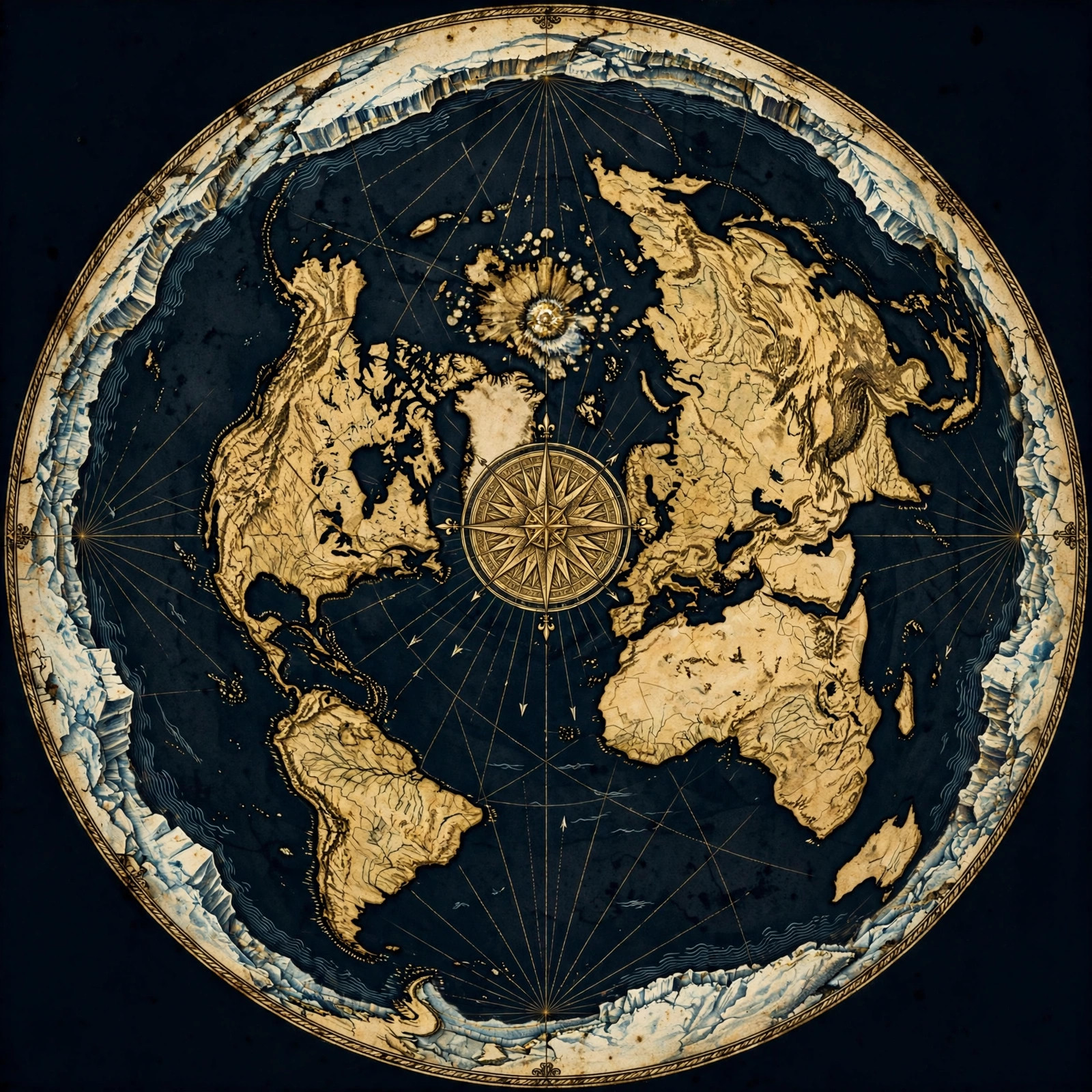
Don't take our word for it — verify it yourself. These historic flat earth maps let you trace the evidence in this article with a ruler and see the truth firsthand.
As an Amazon Associate we earn from qualifying purchases. See also our Amazon Finds page for more research gear.
Frequently Asked Questions
If the Earth is flat, why does a ship's hull seem to disappear before the mast?
Because the hull's vertical angle shrinks below what your eye can resolve against textured water, while the taller mast still spans a visible angle. It's angular resolution and perspective, not a physical obstruction. Magnify the view and the hull returns.
Has anyone actually zoomed in on a ship that 'disappeared' and seen it again?
Yes, repeatedly. Observers with telephoto lenses, telescopes, and high-zoom cameras routinely recover hulls that had supposedly sunk below the curve. If curvature physically blocked the light, no lens could restore it. The recovery proves the light never stopped arriving.
What about photos showing ships half-sunk below the horizon?
Those images usually show atmospheric refraction or inferior mirages, where temperature gradients compress the lower portion of the ship into the waterline. The hull isn't occluded by water; its light is being bent and layered by the air between you and it.
Doesn't the horizon prove the Earth is curved?
No. On a flat plane, the horizon is the convergence line where perspective and atmospheric haze meet — it rises to eye level and stays there, exactly as flat-surface geometry predicts. A globe would put the horizon visibly below eye level when elevated.
Why is the hull-first argument so widely repeated if it's wrong?
Because it's intuitive, visual, and requires no instruments. It feels self-evident, which makes it persuasive. But it collapses under magnification and atmospheric analysis. That's precisely why it's promoted so heavily — and why testing it yourself is so revealing.
Stop Believing. Start Observing.
The hull-first disappearing ship is the most repeated proof of the globe — and the easiest one to dismantle with your own eyes. Angular resolution explains the shrink. Perspective explains the vanishing point. Atmospheric refraction explains the mirages. None of it requires a curved ocean, and all of it is testable this weekend.
So don't take our word for it. Don't take theirs either. Get a zoom lens, find a long sightline, and watch a ship vanish — then bring it back. The moment that hull reappears, something shifts inside you. You stop trusting the story and start trusting your senses.
Explore the proofs, dig through the FAQ, and join the growing community of people who decided to check for themselves. Question everything — especially the things you were told never to question.
Your eyes are the experiment. Go run it.
JOIN THE DISCUSSION