Physics · Rotation
The Coriolis Effect Examined: A Flat Earth Perspective
What Is the Coriolis Effect?
The **Coriolis effect** is the apparent deflection of moving objects when viewed from a rotating frame of reference. On a spinning globe, it's said to curve winds and currents. But on a flat, stationary Earth, such deflections must have a different cause.
If you've ever debated the shape of the Earth, you've likely encountered the Coriolis effect. It's the supposed force that makes hurricanes spin counterclockwise in the Northern Hemisphere and clockwise in the Southern Hemisphere. According to globe proponents, this is due to the Earth's rotation: as air moves from high to low pressure, the ground beneath it moves at different speeds, causing an apparent curve.
But here's the catch: the Coriolis effect is not a real force. It's a mathematical artifact that only appears when you assume a rotating reference frame. On a flat, motionless Earth, there is no rotation, so the standard explanation falls apart. Yet we still observe swirling storms and ocean currents. So what's really going on?
In this post, we'll examine the Coriolis effect from a flat earth perspective. We'll look at the evidence, the inconsistencies, and the alternative explanations that better fit a stationary plane. Buckle up—it's going to be a wild ride.
The Globe's Explanation for the Coriolis Effect
Globe proponents claim the **Coriolis effect** arises because Earth rotates faster at the equator than at the poles. As air travels north or south, it retains its eastward momentum, causing deflection. This is taught as fact, but it relies on unproven assumptions.
The standard globe model says the Earth spins once every 24 hours. At the equator, the surface moves at about 1,670 km/h. At the poles, it's essentially zero. When air moves from the equator toward the poles, it keeps its eastward speed, so it appears to curve to the right in the Northern Hemisphere and to the left in the Southern Hemisphere.
This explanation is elegant on paper, but it hinges on the Earth actually rotating. If the Earth is stationary—as flat earth theory holds—then the Coriolis effect as described cannot exist. Instead, we must look for other mechanisms that produce the same observed patterns.
Moreover, the globe model has its own problems. For instance, the Coriolis effect is often invoked to explain why planes don't fly straight paths, but in reality, pilots correct for wind, not for Earth's rotation. The effect is tiny over short distances and only becomes significant over large scales—conveniently, where verification is difficult.
Problems with the Coriolis Effect on a Globe
The **Coriolis effect** fails to explain why some storms spin the 'wrong' way, and its magnitude is often exaggerated. On a globe, we'd expect consistent patterns, but reality shows anomalies that suggest a different cause.
One of the biggest issues with the Coriolis effect is that it's not as consistent as textbooks claim. For example, there are numerous reports of hurricanes and typhoons spinning in the 'wrong' direction for their hemisphere. If the Earth's rotation were the sole cause, such anomalies should be impossible.
Another problem: the Coriolis effect is said to be zero at the equator, yet storms can and do form near the equator. In 2001, Typhoon Vamei formed just 1.5 degrees north of the equator—a rare event that contradicts the idea that the Coriolis force is necessary for cyclogenesis.
Furthermore, the effect is mathematically derived from a rotating sphere, but it's often applied inconsistently. For instance, the Coriolis effect on a bullet or artillery shell is negligible compared to wind and other factors, yet it's sometimes cited as proof of rotation. This selective use suggests that the Coriolis effect is more of a patch to save the globe model than a robust phenomenon.
A Flat Earth Perspective on Coriolis
On a flat, stationary Earth, the **Coriolis effect** is not needed. Instead, we can attribute swirling storms to local pressure gradients, temperature differences, and electromagnetic forces. The observed patterns can be explained without a spinning globe.
If the Earth is a flat, motionless plane, then there is no rotation to create a Coriolis effect. So how do we explain the clockwise and counterclockwise rotations of weather systems? The answer may lie in the unique properties of the flat earth model.
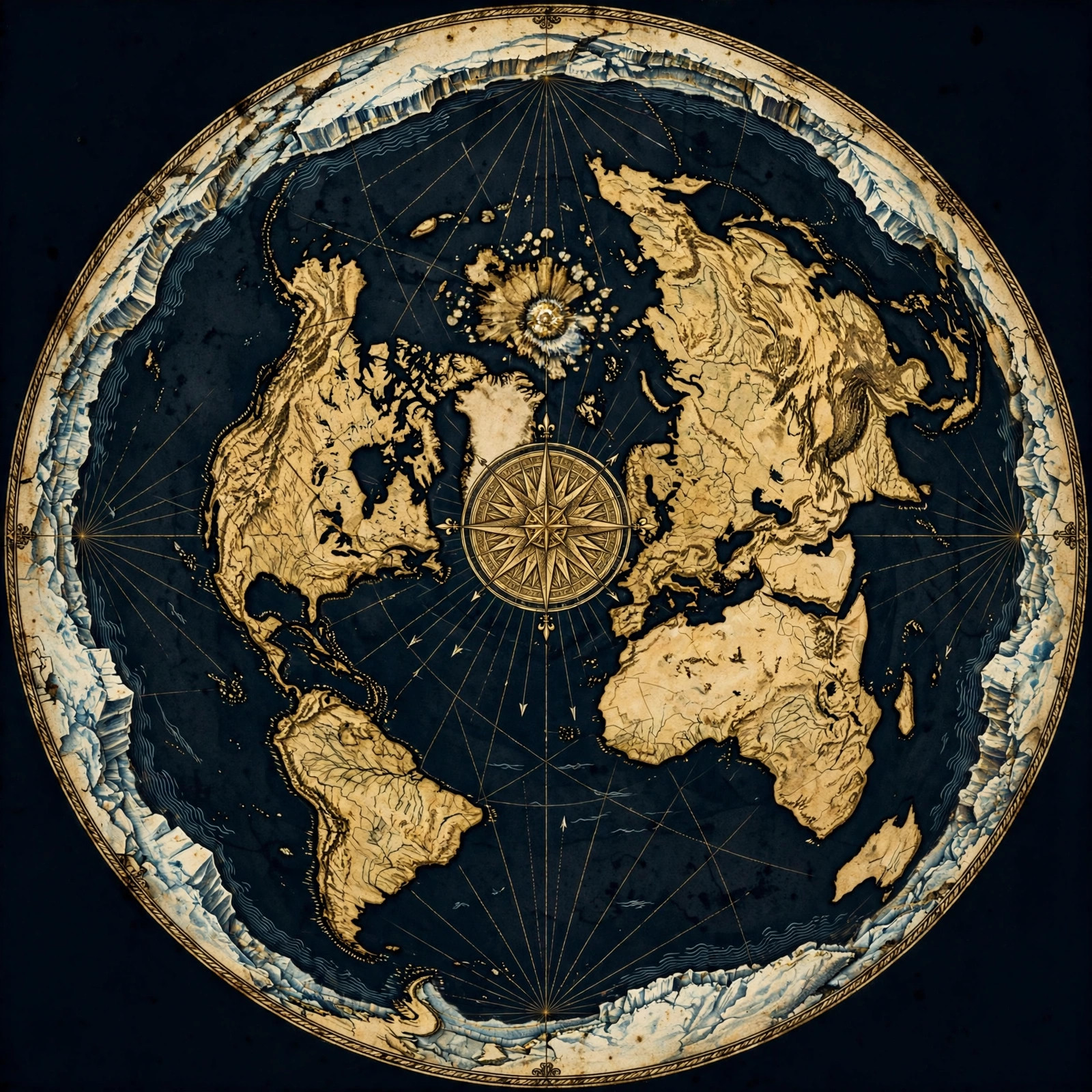
In many flat earth models, the North Pole is at the center, and the continents radiate outward. The sun and moon move in circular paths above the plane, creating day and night. This motion could induce large-scale atmospheric circulation patterns that mimic the Coriolis effect.
Additionally, electromagnetic forces may play a role. The Earth's magnetic field and atmospheric electricity could influence the direction of storm rotation. Some researchers have proposed that the interaction between charged particles and the magnetic field creates the observed swirls. While more study is needed, this is a promising avenue that doesn't require a spinning ball.
For more on flat earth physics, check out our proofs page.
Experiments and Observations
Experiments like the **Foucault pendulum** are often cited as proof of Earth's rotation, but they can be influenced by other factors. On a flat earth, such experiments may not show what they claim.
The Foucault pendulum is the classic demonstration of Earth's rotation. A pendulum swinging freely appears to change its plane of oscillation over time, which is attributed to the Coriolis effect. However, this experiment is not without controversy. Pendulums can be affected by air currents, vibrations, and magnetic fields. In fact, many Foucault pendulum demonstrations require careful isolation and even then show inconsistencies.
Another experiment involves draining water in a bathtub. It's a popular myth that water drains clockwise in the Northern Hemisphere and counterclockwise in the Southern Hemisphere due to the Coriolis effect. In reality, the effect is far too weak to influence a bathtub; the direction is determined by the shape of the basin and residual currents. This shows how the Coriolis effect is often exaggerated.
On a flat earth, we can conduct our own experiments. For instance, observing weather patterns over time might reveal that storm rotations correlate with local factors rather than hemisphere. We encourage everyone to question the official narrative and test for themselves.
Implications for the Flat Earth Model
Reexamining the **Coriolis effect** strengthens the flat earth model by removing a key pillar of globe theory. It opens the door to alternative explanations for weather patterns and other phenomena.
If the Coriolis effect is not what we've been told, then a major argument for the globe collapses. The flat earth model doesn't need a spinning ball to explain the world around us. Instead, it offers a coherent framework where the Earth is stationary and the heavens move above.
This has implications for navigation, meteorology, and even space travel. For example, flight paths are often used to argue for a globe, but flat earth researchers have shown that flights can be better explained on a flat map. Check out our flights page for more details.
By challenging the Coriolis effect, we challenge the entire heliocentric worldview. It's time to question everything, as our motto says. The truth is out there, and it's flat.
Conclusion: Questioning the Coriolis Effect
The **Coriolis effect** is not the ironclad proof of a rotating Earth that we've been led to believe. By examining the evidence, we find inconsistencies and alternative explanations that fit a flat, stationary Earth.
The Coriolis effect is a cornerstone of the globe model, but it's built on shaky ground. From anomalies in storm rotation to the exaggeration of its influence, the effect fails to withstand scrutiny. On a flat earth, we can explain these phenomena through other mechanisms, such as electromagnetic forces and local pressure gradients.
We encourage you to explore our FAQ and blog for more insights. The flat earth movement is growing, and with each passing day, more people are waking up to the truth. Don't be afraid to question everything—especially the things you think you know.
Get the Map and Verify It Yourself
🗺 GET THE TRUE MAP
Don't take our word for it — verify it yourself. These historic flat earth maps let you trace the evidence in this article with a ruler and see the truth firsthand.
As an Amazon Associate we earn from qualifying purchases. See also our Amazon Finds page for more research gear.
Frequently Asked Questions
What is the Coriolis effect in simple terms?
The Coriolis effect is the apparent deflection of moving objects on a rotating Earth. It's said to cause winds and currents to curve. However, on a flat, stationary Earth, this effect doesn't exist, so other explanations are needed.
Does the Coriolis effect prove the Earth is round?
No, the Coriolis effect is derived from the assumption of a rotating sphere. It's not independent proof. On a flat earth, similar patterns can arise from other factors, so it doesn't conclusively prove a globe.
Why do hurricanes spin differently in each hemisphere?
Globe proponents attribute this to the Coriolis effect. Flat earth researchers suggest it could be due to electromagnetic forces, pressure gradients, or the unique geography of the flat earth model, where the center is the North Pole.
Can the Coriolis effect be demonstrated in a bathtub?
No, the Coriolis effect is too weak to influence water draining in a bathtub. The direction is determined by the basin's shape and water currents. This is a common myth that exaggerates the effect's strength.
What are some flat earth alternatives to the Coriolis effect?
Alternatives include electromagnetic forces, atmospheric pressure differences, and the motion of the sun and moon above the flat plane. These can create swirling patterns without needing a rotating Earth.
Join the Flat Earth Movement
The Coriolis effect is just one of many so-called proofs of a globe that fall apart under scrutiny. At flatearther.world, we're dedicated to questioning everything and seeking the truth. If you're ready to challenge the mainstream narrative, explore our proofs, browse our maps, and visit our store to support the movement. Together, we can awaken others to the flat earth reality. The truth is flat—share it!
JOIN THE DISCUSSION