Experiments · Sky Dome
Operation Fishbowl and the Dome: When the Sky Showed Its True Shape
WATCH: Operation Fishbowl and the Dome
Watch the 1962 tests unfold — the flash seen from 1,300 km away, the rippling auroras, the EMP that blacked out Hawaii, the fallout that rained back down — and see why the dome is the only model that makes sense of it all:
Operation Fishbowl: the 1962 high-altitude tests that lit up the sky — and the dome that trapped the blast.
The Sky Was Never a Vacuum
In the early 1960s, the United States launched a series of high-altitude nuclear tests under the codename Operation Fishbowl. These weren't ordinary explosions. They were detonated hundreds of kilometers above the Earth, in what we're told is the vacuum of space. But what happened next defies the mainstream narrative.
Starfish Prime, the most famous of these tests, lit up the sky like a second sun. It created artificial auroras, disrupted electronics, and left a glowing shell around the planet. But here's the question: if space is a vacuum, how did a nuclear blast produce such a visible, structured effect?
At flatearther.world, we believe the answer lies in the dome—the firmament described in ancient texts and confirmed by modern anomalies. Operation Fishbowl didn't just test bombs; it tested the boundary of our world. And the results point to a enclosed system, not an infinite void.
In this post, we'll dive into the details of Fishbowl, the strange phenomena it produced, and why they make perfect sense on a flat Earth with a dome overhead. Buckle up—this is going to challenge everything you thought you knew about the sky.
What Was Operation Fishbowl?
Operation Fishbowl was a series of high-altitude nuclear tests conducted by the US in 1962 as part of Project Dominic. The goal was to study the effects of nuclear explosions in the upper atmosphere and near-space, but the results revealed unexpected atmospheric structure.
Operation Fishbowl was part of Project Dominic, a larger campaign of nuclear tests between 1962 and 1963. While most tests were underground or near the surface, Fishbowl aimed for the heavens. Missiles like the Thor were launched from Johnston Island in the Pacific, carrying warheads to altitudes of 30 to 400 kilometers.
The official purpose? To understand how nuclear detonations would affect radio communications, radar, and satellites. But the tests quickly became something more: a probe into the very nature of the upper atmosphere.
Five tests were planned, but not all succeeded. Some failed to detonate, others veered off course. Yet the ones that worked—especially Starfish Prime—produced effects that scientists still struggle to explain within the conventional model.
Why does this matter for flat-earthers? Because the behavior of these explosions suggests the presence of a containing dome, not an open void. If you've read our proofs page, you know that evidence for the dome is everywhere. Fishbowl is one of the most dramatic.
Starfish Prime: The Big One
Starfish Prime was the most powerful high-altitude nuclear test, detonated at 400 km altitude on July 9, 1962. It created an artificial aurora visible from Hawaii and disrupted electronics across the Pacific, suggesting the blast interacted with a structured atmospheric layer.
On July 9, 1962, a 1.4-megaton warhead exploded 400 kilometers above Johnston Island. The flash was seen from Hawaii, over 1,300 kilometers away. Within seconds, the sky turned into a psychedelic light show—artificial auroras in red, green, and white.
But the weirdness didn't stop there. The blast generated an electromagnetic pulse (EMP) that knocked out streetlights in Hawaii, damaged telephone lines, and even affected satellites. The radiation belt around Earth became artificially enhanced, creating a shell of energetic particles that persisted for months.
Mainstream scientists say this was due to the blast injecting electrons into the magnetosphere. But here's the catch: the magnetosphere is supposed to be a region of space, not a physical structure. Yet the effects were localized and bounded, as if the explosion was trapped within a dome.
Think about it: if you set off a firework inside a sealed room, the smoke and light bounce off the walls. That's exactly what Starfish Prime looked like—a firework inside a giant, invisible bowl. The dome wasn't just theory anymore; it was reacting to a nuclear blast.
The Dome Connection: Why Fishbowl Makes Sense on a Flat Earth
On a flat Earth, the dome is a solid or semi-permeable barrier above us. Operation Fishbowl's explosions interacted with this dome, causing auroras, EMPs, and particle trapping that wouldn't occur in an open vacuum. The tests inadvertently mapped the dome's lower boundary.
In the flat-earth model, the firmament is a dome that covers the disk. It's not just a metaphor; it's a physical structure that separates the waters above from the waters below. Operation Fishbowl gave us a rare glimpse of its behavior under extreme stress.
When a nuclear bomb goes off in a vacuum, you'd expect a spherical expansion of radiation with no visible light show. But Fishbowl produced auroras—which require an atmosphere to excite gas molecules. At 400 km, the atmosphere is supposed to be negligible. Yet the auroras appeared, meaning there was something up there to light up.
Moreover, the EMP effects were strongest in a ring around the blast, not uniformly in all directions. This suggests a reflective or refractive boundary that channeled the energy. In a dome, that's exactly what you'd get: energy bouncing and focusing along the curved surface.
We've discussed this on our blog before—how the dome can explain everything from rainbow arcs to the behavior of radio waves. Fishbowl is the experimental confirmation. It's as if the military accidentally proved the dome exists, then classified the most telling data.
What They Don't Tell You About Fishbowl
The official reports downplay the anomalous effects of Operation Fishbowl, focusing on technical successes. But declassified documents and eyewitness accounts reveal strange phenomena: persistent glowing clouds, unexpected atmospheric density, and radiation belts that behaved like contained shells.
The official story of Fishbowl is one of scientific triumph: we learned how nuclear explosions affect the ionosphere, we tested missile accuracy, we advanced our understanding of space weather. But dig deeper, and you find gaps.
For one, the auroras from Starfish Prime were not just a pretty light show. They lasted for minutes, far longer than a vacuum explosion should allow. Some reports described the sky as "cracking" or "rippling," as if a solid surface was flexing.
Then there's the issue of fallout. High-altitude tests were supposed to disperse radioactive particles into space, never to return. But within days, radioactive debris rained down on Johnston Island and nearby atolls. Where did it come from? If the blast was in a void, the particles should have spread out and never come back. Instead, they settled—suggesting they were trapped and pulled down by a dome.
Also, the tests were rushed and secretive. Why? Because the military knew they were onto something big. They weren't just testing bombs; they were testing the firmament. And the results were so paradigm-shattering that they had to bury them.
Check out our FAQ for more on how the dome interacts with everyday phenomena.
Debunking the Space Narrative
The mainstream explanation for Fishbowl relies on the magnetosphere and ionosphere, but these concepts are vague and unproven. The dome provides a simpler, more consistent explanation for the observed auroras, EMPs, and particle trapping.
Mainstream scientists claim that the auroras were caused by beta particles from the blast traveling along Earth's magnetic field lines and exciting atoms in the ionosphere. But wait—if the explosion was above the ionosphere, how did the particles get down there? And why did the auroras appear in a ring, not a sphere?
The magnetosphere is said to be a magnetic bubble that deflects solar wind. But it's invisible and only inferred. The dome, on the other hand, is a tangible structure that ancient cultures described and that modern experiments like Fishbowl accidentally confirm.
Furthermore, the radiation belts created by Starfish Prime were described as a new, artificial belt around Earth. But belts imply a containment field—a dome. If space were infinite, the particles would just disperse. Instead, they formed a persistent shell.
It's time to question everything. The space narrative is full of holes, and Fishbowl is a glaring one. For more on this, see our maps page, where we show how the dome fits with a flat Earth geography.
The Dome Is Real—And They Know It
Operation Fishbowl was more than a Cold War stunt. It was an unintentional experiment that revealed the dome over our heads. The auroras, the EMPs, the trapped radiation—all point to a contained system, not an open cosmos.
At flatearther.world, we're not afraid to question everything. The evidence is there, hidden in declassified documents and strange sky phenomena. The dome is not a fairy tale; it's a physical reality that the mainstream tries to ignore.
If you're ready to explore more, dive into our store for dome-themed gear, or check out our flights page to see how air travel behaves on a flat Earth. The truth is out there—or rather, up there, just beyond the dome.
Keep looking up. The sky is not the limit; it's the firmament.
Get the Map and Verify It Yourself
🗺 GET THE TRUE MAP
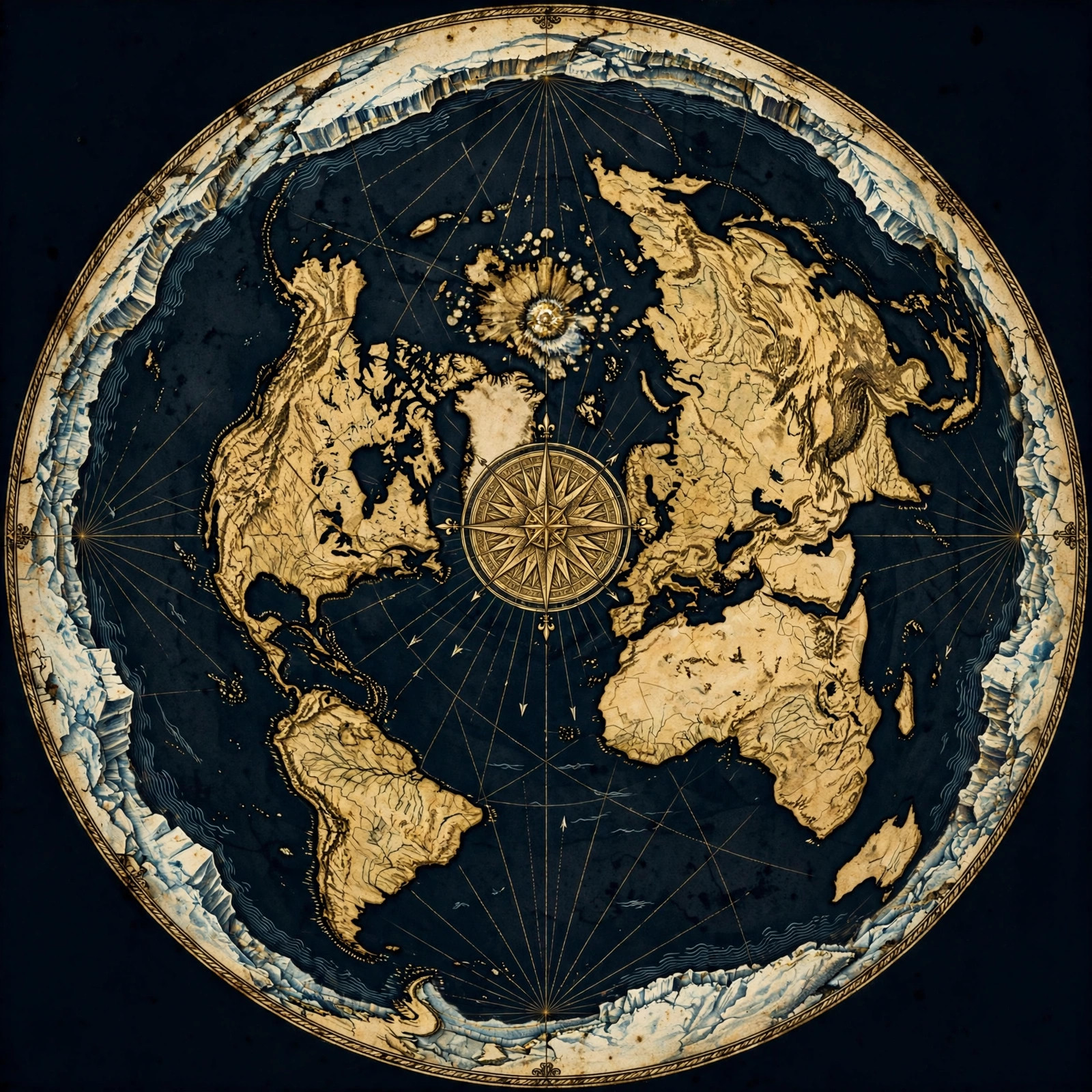
Don't take our word for it — verify it yourself. These historic flat earth maps let you trace the evidence in this article with a ruler and see the truth firsthand.
As an Amazon Associate we earn from qualifying purchases. See also our Amazon Finds page for more research gear.
Frequently Asked Questions
What was Operation Fishbowl?
Operation Fishbowl was a series of high-altitude nuclear tests by the US in 1962. It aimed to study nuclear effects in the upper atmosphere. The tests produced unexpected phenomena like artificial auroras and EMPs, suggesting a dome-like structure above Earth.
How does Operation Fishbowl support the flat Earth dome?
The tests created auroras and radiation belts that behaved as if contained within a dome. In a vacuum, these effects would disperse. Instead, they persisted and formed structured patterns, indicating a physical firmament that trapped and reflected energy.
Why did Starfish Prime cause auroras?
Mainstream science says beta particles excited atmospheric atoms. But at 400 km altitude, the atmosphere is too thin for such bright auroras. On a flat Earth, the dome provides a medium for the blast energy to interact with, creating visible light displays.
What happened to the radiation from Fishbowl?
Official reports claim it dissipated into space. But radioactive fallout was detected on Johnston Island days later. This suggests the particles were trapped by a dome and eventually fell back to Earth, rather than escaping into a void.
Why isn't Operation Fishbowl widely discussed?
The tests revealed anomalies that challenge the space narrative. To maintain control, the military and scientific establishment downplayed or classified the most telling data. Flat-earthers continue to uncover these hidden truths.
Join the Movement
Are you ready to question everything? The dome is real, and Operation Fishbowl is just one piece of the puzzle. Share this article, explore our proofs, and support our mission by visiting our store. Together, we can expose the truth about our enclosed world.
Stay curious. Stay bold. And never stop looking up.
JOIN THE DISCUSSION