Experiments · Shadow Angles
Eratosthenes' Shadow Trick: Why the Globe's Favorite Proof Falls Flat
Introduction: The Legend of the Shadow
Every schoolchild learns the story: Eratosthenes, a Greek astronomer, measured shadows in two Egyptian cities and calculated the Earth's circumference with stunning accuracy. It's presented as the ultimate proof of a spherical Earth. But what if we told you this experiment is not the slam-dunk it's made out to be? At flatearther.world, we question everything. And when you scrutinize Eratosthenes' method, you'll find hidden assumptions and a simpler explanation that fits a flat Earth.
What Eratosthenes Actually Did
Eratosthenes observed that at noon on the summer solstice, a vertical stick in Syene cast no shadow, while in Alexandria, a stick cast a shadow of about 7 degrees. Assuming the Sun's rays are parallel, he used this angle to estimate Earth's circumference. But this conclusion hinges on the assumption of a distant Sun and a spherical Earth.
Eratosthenes' experiment is elegantly simple. He noted that at noon on the summer solstice, the Sun was directly overhead in Syene (modern Aswan), as evidenced by the lack of shadow at the bottom of a deep well. At the same time in Alexandria, roughly 800 km north, a vertical stick cast a shadow with an angle of about 7.2 degrees. Assuming the Sun's rays are parallel, he reasoned that the angle difference was due to the curvature of the Earth, and thus calculated the circumference.
But here's the catch: the entire conclusion rests on two unproven assumptions. First, that the Sun is infinitely far away and its rays are parallel. Second, that the Earth is a sphere. Remove either assumption, and the experiment proves nothing about a globe.
The Hidden Assumptions of the Globe Model
The globe interpretation assumes a distant Sun with parallel rays and a spherical Earth. However, if the Sun is relatively close and moves in circles above a flat plane, the same shadow angles occur naturally. Thus, the experiment is not a proof but an interpretation based on unverified premises.
In the globe model, the Sun is said to be 93 million miles away, so its rays arrive parallel. But this is an assumption, not a measured fact. If the Sun were much closer—say, a few thousand miles—its rays would diverge, and the shadow angles would depend on distance and position. Under a flat Earth model with a local Sun, the observations at Syene and Alexandria can be explained without any curvature.
Moreover, the distance between Syene and Alexandria was estimated by travelers' tales, not precise measurement. Eratosthenes' result, often celebrated as accurate, is actually based on shaky ground. For more on the flaws of globe proofs, see our proofs page.
A Flat-Earth Explanation: The Local Sun
On a flat Earth, the Sun is a relatively small, local body moving in a circular path above the plane. When it is directly over Syene, its light hits Alexandria at an angle, creating the observed shadow. This model requires no curvature and fits the simple geometry of the experiment.
Imagine a flat plane with a Sun moving in a circle above it. At the moment it is directly over Syene, its rays strike Alexandria at an angle. The angle depends on the height of the Sun and the distance between the two cities. With the right combination, you get exactly 7.2 degrees. No globe needed.
This is not just a hand-wave; it's a geometric alternative. In fact, many flat-earth researchers have replicated the shadow experiment and found that a local Sun model predicts the angles just as well. Check out our blog for more experiments.
Other Factors Eratosthenes Ignored
Eratosthenes assumed Syene and Alexandria were on the same meridian, but they are not exactly. He also ignored atmospheric refraction and the uneven terrain. These factors introduce errors that undermine the precision attributed to his result.
Eratosthenes' calculation assumes the two cities lie on the same north-south line. In reality, Alexandria is slightly west of Syene, so the shadow angle is not purely due to latitude difference. Atmospheric refraction can also bend light, especially near the horizon, though at noon it's less of an issue. Still, these details are glossed over in textbooks.
Furthermore, the exact length of the stadion (the unit he used) is unknown, making his final circumference figure uncertain. The supposed accuracy is more legend than fact.
Modern Replications and Their Flaws
Modern attempts to replicate Eratosthenes' experiment often use GPS and precise clocks, but they still assume a globular Earth. When flat-earth researchers repeat the test with a local Sun model, they get consistent results. The experiment is not a globe-proof.
Today, people repeat the shadow experiment with smartphones and GPS, but they interpret the data through a globe lens. They measure angles, plug them into the globe formula, and declare victory. But if you use the flat-earth formula with a local Sun, you get the same angles. The experiment is neutral; it's the interpretation that differs.
For a deeper dive into how flat-earth models explain such phenomena, visit our FAQ.
Conclusion: Question the Shadow, Question the Globe
Eratosthenes' experiment is not the irrefutable proof of a globe that we've been told. It relies on assumptions that flat-earthers reject, and a flat-earth model with a local Sun explains the observations just as well. At flatearther.world, we encourage you to question everything. Don't accept a 2,000-year-old story without scrutiny. Test it yourself, and see which model fits the evidence.
Get the Map and Verify It Yourself
🗺 GET THE TRUE MAP
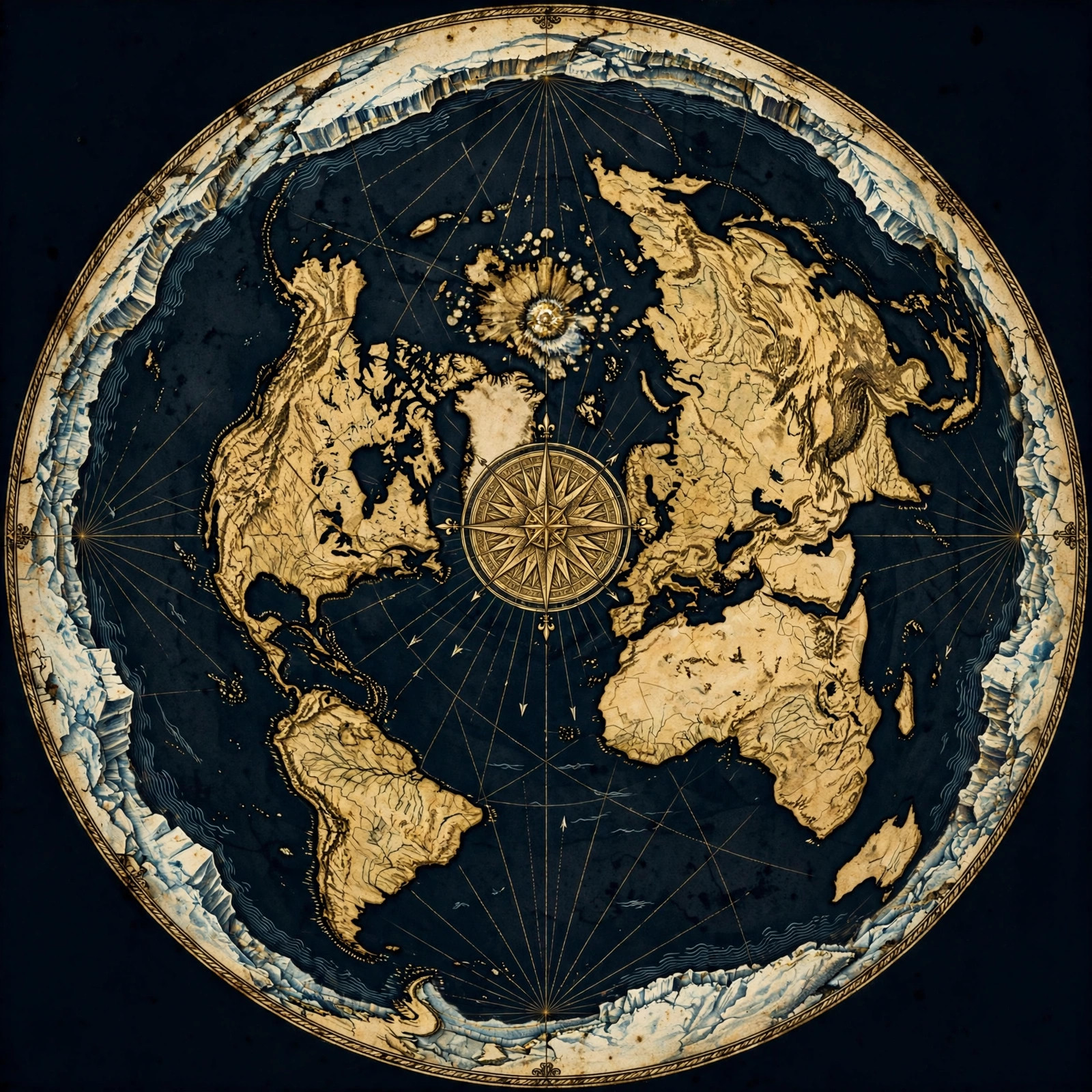
Don't take our word for it — verify it yourself. These historic flat earth maps let you trace the evidence in this article with a ruler and see the truth firsthand.
As an Amazon Associate we earn from qualifying purchases. See also our Amazon Finds page for more research gear.
Frequently Asked Questions
Did Eratosthenes prove the Earth is round?
No, he only showed that shadow angles differ between two cities. That observation is consistent with both a globe and a flat Earth with a local Sun. His conclusion relied on assuming a distant Sun and a spherical Earth, neither of which is proven.
How can a flat Earth explain the different shadow angles?
On a flat Earth, the Sun is a relatively small, local body moving in a circle above the plane. When it is directly over Syene, its light hits Alexandria at an angle, creating a shadow. The angle depends on the Sun's height and the distance between cities.
Was Eratosthenes' measurement accurate?
His result is often cited as accurate, but the distance between Syene and Alexandria was estimated, and the length of the stadion is unknown. Also, the cities are not on the same meridian. So the precision is exaggerated.
What about modern replications of the experiment?
Modern replications still assume a globe. When flat-earth researchers use a local Sun model, they get consistent results. The experiment itself doesn't distinguish between the two models; interpretation does.
Why do globers ignore the flat-earth explanation?
Many are unaware of the alternative or dismiss it without investigation. At flatearther.world, we encourage open-minded examination. The flat-earth model explains the shadow experiment without curvature, so it deserves consideration.
Join the Flat Earth Movement
Ready to challenge the globe? Explore our store for books, shirts, and more. Check out our flights page to see how travel times debunk the globe. And don't forget to share this article with someone who needs to question everything. Together, we can spread the truth.
JOIN THE DISCUSSION